
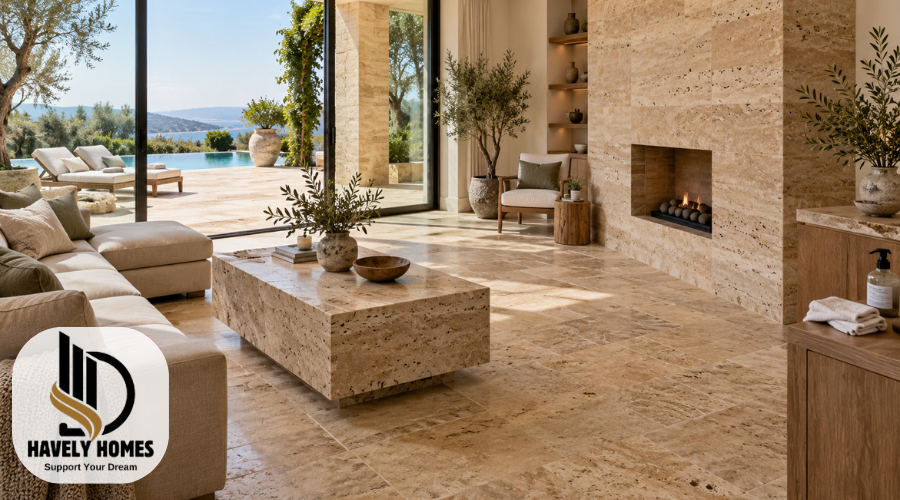
Travertine is a natural stone that can bring warmth, texture, and visible character into a home. It is commonly used for floors, walls, backsplashes, patios, decorative features, and stone furniture. Unlike manufactured tiles designed to look identical, natural travertine can show changes in color, pores, bands, and pattern from one piece to another.
That variation is one of the reasons homeowners choose it, but it also means travertine needs thoughtful selection and care. The right finish for a living-room floor may not be the best choice for a wet area or outdoor patio. Cleaning products also need to be chosen carefully because the stone can react with acids.
This guide explains what travertine is, how different finishes and cuts change its appearance, where it can be used around the home, and what to know about cleaning, sealing, installation, and long-term maintenance.
Quick Answer:
Travertine is a natural limestone used for flooring, walls, patios, backsplashes, and furniture. Its appearance and performance vary, so check the stone’s finish, intended application, maintenance needs, and supplier guidance before installation.
Quick-Guide Table
| Possible problem | What to check | Recommended action |
| Dull or etched surface | Whether vinegar, lemon, or another acidic product contacted the stone | Stop using acidic cleaners and use a natural-stone-safe cleaner; seek professional restoration for noticeable etching |
| Stains or dark marks | Recent spills, oils, food, toiletries, or moisture exposure | Blot spills promptly and follow stone-specific cleaning guidance |
| Scratches or surface wear | Abrasive cleaners, grit, furniture movement, or heavy traffic | Remove grit regularly and avoid abrasive cleaning tools |
| Loose or damaged filler | Natural holes where factory or installation fill has deteriorated | Have larger or recurring damaged areas assessed by a stone professional |
| Outdoor deterioration | Climate, moisture exposure, drainage, and freeze-thaw conditions | Confirm that the specific travertine is suitable for exterior use in your climate |
| Uneven color or pattern | Whether the variation is natural across different pieces | Review and blend tiles before installation rather than expecting identical pieces |
Helpful Steps Before Choosing Travertine
- Decide whether the stone will be used indoors, outdoors, or in a wet area.
- Look at several actual samples instead of judging the material from one tile.
- Compare the color range, pores, fill, cut, and surface finish.
- Confirm that the specific product is suitable for your intended location.
- Ask about cleaning and sealing requirements before buying.
- Check exterior suitability carefully in areas exposed to freezing conditions.
- Use an experienced natural-stone installer when waterproofing, substrate preparation, structural concerns, or complex installation is involved.
What Is Travertine?
Travertine is a type of limestone formed when calcium carbonate is deposited from mineral-rich water. The U.S. Geological Survey describes travertine as limestone composed mainly of calcite and aragonite, both forms of calcium carbonate. In natural spring environments, changes in pressure, temperature, and dissolved carbon dioxide can cause calcium carbonate to come out of the water and build up in layers.
These layers help create the distinctive appearance of travertine stone. Depending on how the stone formed and how it is cut, you may see small holes, larger voids, bands, irregular pores, veins, or changes in color.
Some travertine is sold filled, meaning many of its natural holes have been filled during processing to create a smoother surface. Other products are unfilled, leaving more of the original openings visible. Neither approach is automatically better. The right option depends on the appearance, location, finish, and maintenance level you want.
If you are wondering about travertine pronunciation, American English commonly uses versions similar to “TRAV-er-teen” and “TRAV-er-tin.” More than one pronunciation is recognized.
Travertine Colors, Patterns, and Natural Texture
Travertine is best known for soft earth tones. Cream, beige, tan, brown, gold, gray, and reddish shades can all occur. Its exact color depends on the stone deposit and other minerals present during formation.
When people search for travertine white, they are usually looking for a very pale or creamy stone rather than a perfectly uniform bright white surface. Even light-colored travertine can contain warmer areas, veins, pores, or darker markings.
The travertine texture is equally important. Some pieces appear fairly calm and even, while others have obvious holes, bands, movement, and color changes. The Natural Stone Institute notes that travertine can show considerable aesthetic variation, even when material comes from the same quarry. For that reason, looking at a range of samples is more useful than judging an entire order from one small piece.
How the block is cut also changes the pattern. Cross-cut material tends to reveal a more cloud-like or varied pattern, while vein-cut material makes the layered structure more visible and can create stronger linear bands.
For a home project, this variation should be treated as part of the material rather than as a defect. If you want a highly uniform surface with almost no visible change between tiles, a manufactured material may be easier to control.
Travertine Tile and Flooring in the Home
Travertine tile can be used on floors and walls in many residential spaces. Entryways, living rooms, hallways, bathrooms, and feature walls are common examples when the particular tile is suitable for the application.
The main appeal of travertine flooring is its natural appearance. Instead of repeating a printed pattern, each piece can have its own pores, bands, and color movement. This can give a floor more depth and individuality.
However, natural stone floors require practical planning. Surface finish, tile dimensions, thickness, traffic level, substrate condition, and maintenance all matter. Travertine can also be scratched, chipped, etched, or stained under certain conditions, so appearance should not be the only factor in your decision.
The surface underneath the stone deserves special attention. Natural-stone tile should be installed over an appropriate, stable base. MSI’s travertine installation guidance, for example, calls for the supporting floor to be structurally sound and dry and notes that some wood-floor assemblies require additional underlayment or backer material for rigidity. Exact installation requirements should be determined for the particular floor system and product.
For that reason, larger flooring projects are often better assessed by an installer experienced with natural stone, especially where the subfloor, moisture control, waterproofing, or structural suitability is uncertain.
Where Travertine Works Best Around a Home
Travertine is versatile enough to appear in several parts of a house.
Indoors, it can be considered for floors, wall cladding, decorative features, backsplashes, fireplace surrounds, and some bathroom applications. In wet areas, the complete assembly matters—not just the appearance of the stone. Waterproofing, drainage, stone properties, finish, and installation details all need to suit the location. The Natural Stone Institute’s current design guidance treats stone wet areas as applications with their own requirements for factors such as soundness, porosity, waterproofing, and slope.
Outside, travertine is used for patios, walkways, paving, pool surrounds, and other hardscape features. However, outdoor suitability should never be assumed simply because a product is labeled travertine.
The Natural Stone Institute specifically notes that although many limestone products have performed successfully outdoors, fewer have a proven history as exterior paving in freeze-thaw environments.
If your project will face freezing winters, frequent saturation, pool chemicals, heavy traffic, or other demanding conditions, check technical information for the exact stone and ask a qualified stone supplier or installer whether it is suitable.
Understanding Travertine Finishes
The finish changes both how travertine looks and how it behaves in everyday use. Common options include honed, polished, tumbled, brushed, and other textured finishes. The Natural Stone Institute recognizes several of these as established finishes used with travertine.
Honed travertine has a smooth surface without the strong reflection of a high polish. It is often selected when homeowners want a softer, understated appearance.
Polished travertine has a glossier, more reflective surface. The Natural Stone Institute defines a polished finish as a highly reflective surface that brings out the stone’s color and character.
Tumbled travertine generally has a more weathered or aged appearance, while brushed or textured surfaces can emphasize the stone’s natural character.
Filled and unfilled surfaces create another visual difference. Filling can make the face easier to keep smooth, while unfilled stone retains more visible openings.
Do not choose a wet-area or outdoor finish based only on the belief that “rough means safe.” Slip performance depends on the actual stone, finish, contaminants, installation, and conditions. Ask for technical information appropriate to the intended location.
Advantages and Drawbacks of Travertine
Travertine has several qualities that make it attractive for home design. It is genuine natural stone, so its pores, color movement, and patterns are real rather than printed. It is available in multiple cuts and finishes and can be used in both large surfaces and smaller decorative features.
Its cream, beige, brown, gray, and gold tones can fit comfortably into traditional, Mediterranean, rustic, transitional, and even restrained modern spaces. The stone can look subtle when the color range is narrow or more expressive when strong veining and variation are allowed to stand out.
Those benefits come with trade-offs.
Travertine is a calcium-carbonate stone, so acidic materials can damage its surface. Natural holes may also require filling or future repair. Scratches, chips, staining, and visible wear are possible depending on the product and conditions.
It is also important not to describe all travertine as having exactly the same strength or porosity. Natural stone varies by source and variety. Industry standards therefore include specific tests for properties such as water absorption, strength, flexure, and abrasion rather than assuming all travertine behaves identically.
If low maintenance and highly uniform appearance are your priorities, consider these differences before committing to a large area.
Is Travertine Marble?
You may see the phrase travertine marble in shops, older descriptions, or online listings, but geologically it is misleading.
Travertine is a type of limestone rather than true marble. The Natural Stone Institute specifically points out that the traditional commercial expression “travertine marble” does not change its geological classification as limestone.
The two stones can sometimes look similar after cutting and finishing, but their formation is different. Travertine is a sedimentary carbonate rock formed through mineral deposition from water. Marble develops when limestone or another carbonate rock is changed by heat and pressure.
From a homeowner’s point of view, an important similarity is that both are largely calcium-carbonate-based materials and need care around acids. Vinegar, lemon juice, and acidic cleaning products can dull or etch calcareous natural stone.
So, when comparing travertine with marble, look beyond appearance. Ask about the actual stone type, finish, intended application, cleaning requirements, and technical properties of the product you are considering.
Cleaning, Sealing, and Maintaining Travertine
Regular maintenance does not need to be complicated, but travertine should be treated as natural stone rather than cleaned with whatever general-purpose product happens to be nearby.
Remove loose grit and dirt regularly, particularly from floors. Small abrasive particles tracked in on shoes can contribute to surface wear. Clean spills reasonably quickly rather than allowing food, drinks, toiletries, oils, or colored liquids to remain on the stone.
For routine cleaning, choose a product specifically marked as suitable for natural stone and follow its directions. Avoid vinegar, lemon-based cleaners, and other acidic products. The Natural Stone Institute warns that acids can etch or dull calcareous stones. Abrasive scouring powders may also scratch certain stone surfaces.
Sealing is another area where simple rules can be misleading. An impregnating sealer may help improve resistance to staining, but sealing does not make natural stone completely stain-proof. The Natural Stone Institute describes such treatments as repellents that make stone more stain resistant rather than fully sealed against everything. It also notes that not every stone necessarily requires sealing, so decisions should be made with the stone supplier or sealer manufacturer.
For the same reason, avoid relying on a universal statement such as “reseal every three years.” The correct timing can vary according to the stone, sealer, traffic, exposure, cleaning routine, and manufacturer’s instructions.
Common Travertine Problems and Mistakes to Avoid
Many travertine problems begin with treating natural stone like ceramic or another less acid-sensitive surface. A few common mistakes are worth avoiding:
- Cleaning with vinegar or acidic products: They can etch calcium-carbonate stone.
- Assuming sealing prevents all damage: A sealer may help with staining, but it does not make the surface immune to stains or acid etching.
- Using harsh abrasives: Scouring products can scratch some stone finishes.
- Ignoring damaged fill: Filled travertine can develop areas where filler loosens or deteriorates and may need repair.
- Expecting identical tiles: Variation in holes, texture, vein direction, and color is normal in natural travertine.
- Choosing only by appearance: The location, traffic, moisture, climate, and finish should influence the decision.
- Assuming every travertine works outdoors: Exterior paving, particularly in freeze-thaw climates, requires suitable material.
Minor everyday cleaning is usually straightforward, but deep staining, extensive etching, damaged fill, cracks, loose tiles, or widespread surface problems may require a professional stone-restoration specialist. Trying aggressive chemicals or abrasive tools without knowing the stone and finish can make the damage more difficult to correct.
Choosing Travertine for a Home Project
Start by deciding exactly where the stone will go. A dry interior wall, busy hallway, shower, kitchen backsplash, patio, and pool surround create very different demands.
Next, look at several pieces rather than one perfect display sample. Check the expected range of colors, hole sizes, vein patterns, fill, and finish. The Natural Stone Institute recommends reviewing a range of samples because natural travertine can show significant variation. It also advises blending material from different pallets when appropriate so the finished installation does not develop unintended blocks of color.
Ask the supplier for technical information about the exact material. Confirm that the stone and finish are intended for your planned use, particularly for wet rooms and exterior areas.
Think about maintenance before installation as well. A household that wants to use common acidic cleaners or expects a perfectly unchanged surface may find travertine more demanding than expected. Homeowners comfortable with natural variation and stone-specific care may appreciate its character much more.
Finally, know when installation is beyond a simple DIY project. Proper substrate preparation, waterproofing, movement accommodation, cutting, structural assessment, large-format installation, and exterior work may require professional knowledge. The Natural Stone Institute maintains dedicated standards and guidance for stone selection, installation, wet areas, and travertine itself, reflecting how application-specific natural-stone work can be.
Travertine Beyond Floors: Walls, Backsplashes, and Tables
Travertine does not need to cover an entire floor to make an impact. Smaller applications can bring the same natural texture into a room with less surface area to maintain.
A wall feature or backsplash, for example, can introduce soft earth tones and stone movement without committing the whole room to natural-stone flooring. The finish and sealing requirements should still suit the area, especially behind a kitchen counter where oils, sauces, drinks, and acidic foods may be present.
A travertine table is another way to use the material. The top may show the same pores, bands, and color variation found in architectural stone. Before buying one, consider the weight of the piece, floor protection, how the surface has been finished or sealed, and the manufacturer’s care guidance.
Coasters, placemats, or other surface protection can be useful where food and drinks are served. Acidic liquids should not be allowed to sit on exposed travertine because calcium-carbonate stone can etch when it contacts acids.
Using travertine as a table, small backsplash, shelf, or decorative wall element can also be a practical choice for homeowners who enjoy its natural appearance but do not want the maintenance responsibility of a large stone floor.
Conclusion
Travertine is a distinctive natural limestone that can work beautifully in many parts of a home when the stone, finish, and application are chosen carefully. Its warm colors, pores, bands, and natural variation give it a character that manufactured surfaces cannot exactly reproduce.
That natural character also means homeowners need realistic expectations. Travertine is sensitive to acids, individual pieces can vary noticeably, and some applications require careful sealing, maintenance, substrate preparation, waterproofing, or professional installation.
Before choosing travertine, consider where it will be installed, how much traffic or moisture it will face, whether the particular stone is appropriate for your climate, and how much maintenance you are comfortable providing. Check several samples and review the technical guidance for the actual product rather than relying on general claims about all travertine.
With the right expectations and care routine, travertine can serve as anything from a subtle backsplash or table surface to a major flooring or outdoor design feature while keeping the natural texture and variation that make the stone distinctive.
FAQs
Is Travertine A Type Of Marble?
No. Travertine is geologically a type of limestone, although it is sometimes marketed as “travertine marble.” Both are calcium-carbonate stones, but they form through different geological processes.
Does Travertine Need To Be Sealed?
Some travertine installations benefit from an appropriate impregnating sealer, especially where staining is a concern. However, sealing requirements vary by stone, finish, location, and product, so follow supplier or sealer-manufacturer guidance.
Can Travertine Be Used Outdoors?
Yes, some travertine is suitable for patios, walkways, and other exterior areas. Suitability depends on the particular stone, installation, drainage, climate, and freeze-thaw exposure, so check technical information before installation.
Why Does Travertine Have Holes In It?
The holes and voids are natural features created during the stone’s formation. They may be left visible for texture or filled during processing or installation to create a smoother surface.
Can I Clean Travertine With Vinegar?
No. Vinegar is acidic and can etch calcium-carbonate stone such as travertine. Use a cleaner specifically suitable for natural stone and follow its directions instead.
Disclaimer: This article is provided for general informational purposes only. Travertine is a natural material, so its color, texture, porosity, strength, finish, maintenance needs, and suitability can vary between products and sources. Always check the stone supplier’s technical information, installation instructions, and cleaning or sealer manufacturer’s guidance for your specific product. Complex installation, waterproofing, substrate preparation, structural concerns, significant cracks, deep staining, extensive etching, or stone restoration should be evaluated by a qualified natural-stone installer or restoration professional. havelyhomes.com does not manufacture, sell, install, or officially represent any travertine product or stone supplier.
