
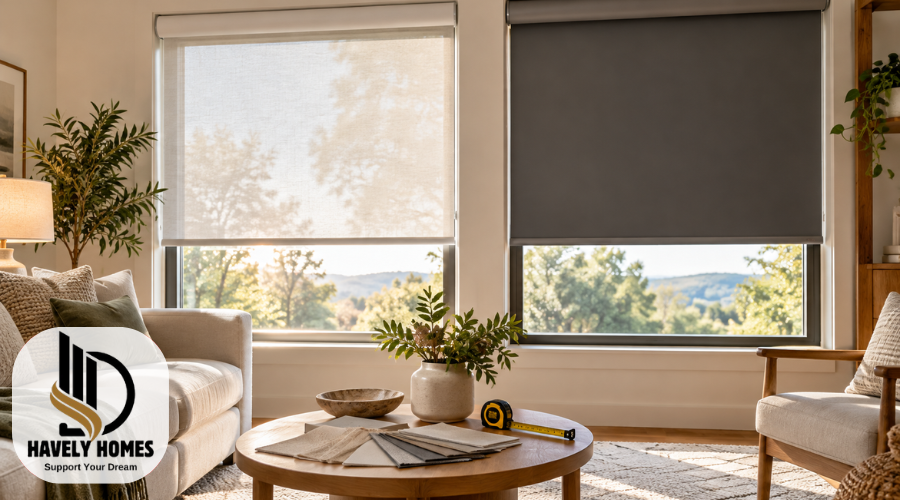
Choosing between roller blinds vs roller shades can be surprisingly confusing. You may see one retailer advertising roller blinds while another sells roller shades that appear almost identical. That is because these terms are often used for very similar roll-up window coverings, especially across different countries and retailers.
For example, Hunter Douglas in the U.S. describes roller shades as a continuous panel of fabric that rolls around a tube, while IKEA UK sells comparable roll-up window coverings under the name “roller blinds.”
So, instead of choosing based only on whether a product is called a blind or a shade, it is more useful to look at its actual construction, fabric, opacity, privacy level, operating system, fit, maintenance needs, and price.
This guide explains those differences in practical terms so you can decide what works best for each room in your home.
Quick Answer:
Roller blinds and roller shades often describe the same roll-up window covering. Instead of focusing on the name, compare the fabric, opacity, privacy, light control, mounting style, operation, and cost.
Quick-Guide Table
| Possible problem | What to check | Recommended action |
| Room is too bright | Fabric opacity and light gaps | Consider room-darkening or blackout material and check mounting coverage |
| Not enough privacy | Fabric transparency, especially at night | Choose a more opaque material or test privacy under indoor lighting |
| Too much screen glare | Direction of sunlight and fabric type | Consider a suitable solar or light-filtering roller material |
| Shade does not fit well | Window measurements and mounting style | Recheck measurements using the manufacturer’s instructions |
| Difficult to keep clean | Fabric care requirements | Choose a material suited to the room and follow its official cleaning guidance |
| Child-safety concern | Accessible cords or loops | Prefer a cordless option where young children are present |
Helpful Steps for Choosing the Right Roller Window Covering
- Decide whether your main goal is privacy, blackout, glare reduction, daylight control, or appearance.
- Check whether you need light-filtering, room-darkening, blackout, or solar material.
- Decide between an inside or outside mount based on your window and desired coverage.
- Measure carefully using the manufacturer’s instructions.
- Check whether the material suits the room, particularly kitchens and bathrooms.
- Compare equivalent products by size, fabric, operation, customization, and installation requirements.
- Prioritize cordless window coverings in homes where young children are present.
Roller Blinds vs Roller Shades: Are They Actually Different?
In everyday shopping, roller blinds and roller shades can refer to essentially the same style of window covering: a flat sheet of fabric or another flexible material that raises by rolling around a tube.
Terminology is one reason for the confusion. “Roller shade” is common wording in the U.S. window-treatment market. In the UK, products with the same basic roll-up design are commonly sold as “roller blinds.”
There is, however, a broader difference between traditional blinds and shades.
A conventional blind, such as a Venetian or vertical blind, generally uses separate slats or vanes. Those pieces can often be tilted to redirect light without completely raising the covering. A shade usually uses a continuous piece of fabric or similar material that moves up and down as one unit.
Roller shades fit the second description. Hunter Douglas describes its roller shades as using a continuous panel that rolls into a tube when raised.
This is why the product specifications matter more than the label. Two products called “roller blinds” and “roller shades” may function almost identically, while two different roller products can provide very different levels of privacy or light control because of their fabrics.
Common options include light-filtering, room-darkening, blackout and solar materials. Depending on the manufacturer, you may also find cordless, manual and motorized operating systems.
Roller Blinds vs Roller Shades at a Glance
The simplest way to compare roller blinds and roller shades is to focus on what you are actually buying rather than the name printed on the packaging.
| Feature | Roller Blinds | Roller Shades |
| Basic construction | Usually a continuous roll-up material | Usually a continuous roll-up fabric or material |
| Appearance | Simple, neat and compact | Clean, streamlined and minimal |
| Light filtering | Depends on material | Depends on material |
| Privacy | Depends on opacity and fit | Depends on opacity and fit |
| Blackout options | Commonly available | Commonly available |
| Outside view | Possible with some screen or solar materials | Possible with some solar materials |
| Maintenance | Often simple, but material-specific | Often simple, but material-specific |
| Operation | Manual, cordless or other systems depending on product | Manual, cordless or motorized options may be available |
| Cost | Depends on size, material and operating system | Depends on size, material and operating system |
| Best rooms | Depends on fabric and privacy needs | Depends on fabric and privacy needs |
The main takeaway is that there is rarely a meaningful universal performance difference based only on the words roller blind and roller shade. Fabric, construction, installation and operating system usually tell you much more.
Roller Blinds vs Roller Shades Pros and Cons
The roller blinds vs roller shades pros and cons are also very similar when the products share the same basic construction.
One of their biggest advantages is their compact appearance. A roller covering sits relatively flat against the window when lowered and takes up little visual space when raised. This can work particularly well in modern or minimalist rooms where bulky window treatments may feel distracting.
Another advantage is variety. Roller coverings are available in different fabrics, textures and opacity levels, giving homeowners choices ranging from softly filtered daylight to strong room darkening.
Cordless and motorized operating options are also available within the wider roller-shade market, although availability depends on the individual manufacturer and model.
There are some limitations. Unlike a slatted blind, a standard roller covering cannot normally tilt individual slats to redirect sunlight. You typically control light by raising or lowering the covering or by selecting a fabric designed for a particular degree of light transmission.
Privacy also depends heavily on the material. A light-filtering fabric that feels private during the daytime may behave differently at night when interior lights are switched on.
Another consideration is edge light. Even when the material itself is designed to block light, small gaps can exist between the fabric and the sides of the window opening. Lutron’s roller-shade measuring guidance specifically accounts for side light gaps, illustrating why the mounting arrangement matters as well as the fabric.
Overall, neither name automatically indicates a better product. The better choice is the covering whose specifications match your room.
Light Control, Privacy, and Blackout Performance
Light control is one of the most important things to consider when choosing roller shades for windows.
A light-filtering material is designed to soften incoming daylight rather than completely eliminate it. This can make a living room or dining space feel bright while reducing harsh direct light.
Room-darkening materials provide stronger light control but should not automatically be treated as full blackout products. Exact terminology can vary by manufacturer, so always check the stated opacity and product description.
Blackout roller shades use materials intended to stop light from passing through the main fabric. They can be useful in bedrooms, nurseries, media rooms and other areas where darkness is particularly important.
However, blackout fabric alone does not guarantee that no light will enter the room. Light may still appear around the sides, top or bottom depending on how the shade is fitted. An outside mount that overlaps the window opening may provide greater surrounding coverage in some installations, while an inside mount usually sits within the recess and can leave visible edge gaps.
Solar shades serve a different purpose. They use screen-like materials intended to reduce glare and harsh sunlight while maintaining more connection with the view outside. Hunter Douglas, for example, describes its solar shades as designed to curb harsh UV exposure while preserving exterior views.
That makes solar designs useful for bright living areas or home offices, but they should not automatically be assumed to provide nighttime privacy. When indoor lighting is brighter than the outside environment, some screen materials can allow greater visibility from outdoors.
For that reason, think about both daytime light control and nighttime privacy before choosing your fabric.
Style, Materials, and Everyday Maintenance
Roller coverings are popular partly because their simple shape works with many decorating styles.
A smooth neutral fabric can create a clean background in a modern room. Textured or woven-looking finishes can add more visual warmth, while patterned materials may become a stronger design feature.
Compared with traditional slatted blinds, roller designs generally create a softer and less structured appearance. They can therefore suit rooms where you want the window treatment to remain visually quiet.
Maintenance depends on the exact fabric or material. Some roller blinds can be gently wiped, while others have more specific cleaning restrictions. IKEA, for example, gives different care directions for individual roller-blind products and advises following their stated product-care information.
A sensible routine is to remove loose dust regularly with a suitable soft method and follow the manufacturer’s instructions before using water or cleaning products. Do not assume that every fabric can be washed or scrubbed.
Material choice also matters in kitchens and bathrooms. Humidity, splashes and cooking residue can make some fabrics less practical than others. Check whether the manufacturer says the specific material is suitable for the environment where you plan to install it rather than choosing only by color or texture.
Roller Blinds vs Roller Shades Cost and What Changes the Price
There is no single useful answer to roller blinds vs roller shades cost because the names themselves do not determine price.
Similarly, a broad roller shades vs blinds cost comparison can be misleading if you are comparing products of different sizes, materials or operating systems.
Window dimensions are one major factor. A larger custom window treatment generally requires more material and potentially different hardware than a small standard-size covering.
Ready-made products may also be priced very differently from made-to-measure options. Fabric type, texture, opacity, blackout construction and decorative details can all influence the final cost.
The operating method matters too. A simple manual design and a motorized system are not directly comparable products. Optional enhancements can further change pricing.
Hunter Douglas states that pricing for its window treatments depends on factors including window size, treatment type, fabric or material, control option and added enhancements.
Installation is another possible cost. Straightforward installations may be manageable for experienced homeowners when the manufacturer’s directions are clear. Larger, unusually shaped or difficult-to-reach windows may justify professional measuring or fitting.
When comparing prices, compare like with like. Use the same approximate dimensions, opacity level, material quality, operating system and installation requirements. Otherwise, the cheaper-looking option may simply have fewer features.
How Roller Shades Compare With Cellular and Roman Shades
Roller shades are not the only fabric-based window coverings worth considering. Cellular shades and Roman shades are common alternatives, but their construction is different.
Cellular shades use a honeycomb-style structure containing air pockets. This construction provides an added insulating layer at the window. Hunter Douglas describes cellular shades as trapping air in distinct pockets to improve insulation and comfort.
That can make cellular shades particularly interesting when energy efficiency and insulation are important priorities.
Roller shades, by comparison, usually have a flatter and simpler construction that rolls around a tube. Their streamlined shape may appeal more to homeowners who want a minimal appearance.
Roman shades focus more strongly on decorative fabric folds. Depending on the design, the material creates soft or crisp folds as the shade is raised. Hunter Douglas offers Roman designs with different fold styles and light-control options.
The choice therefore comes down to priorities. Consider roller shades for a simple profile, cellular shades when their insulating construction suits your needs, and Roman shades when you want a softer, more decorative fabric treatment.
None of these categories is automatically right for every home.
Choosing the Right Option for Each Room
Instead of using one roller covering throughout the entire house, think about what each room actually needs.
In a bedroom, privacy and darkness are usually important. A blackout or strong room-darkening option may make more sense than a translucent fabric, but remember to consider edge gaps as well as the fabric itself.
For a living room, you may want natural daylight without excessive glare. Light-filtering or suitable solar-style coverings can help balance brightness, privacy and the outside view.
In a kitchen, cleaning and material suitability deserve extra attention. A beautiful textured fabric may not be the most practical choice if it is difficult to maintain near cooking areas.
A bathroom needs reliable privacy and a material suitable for the room’s moisture conditions. Check the manufacturer’s recommendations before installing a fabric product in a humid space.
For a home office, consider screen glare. Solar or light-controlling roller materials can be useful when direct sunlight makes a computer display uncomfortable to use.
In a nursery or child’s room, operating safety becomes especially important. The U.S. Consumer Product Safety Commission states that accessible window-covering cords can pose a strangulation hazard and recommends cordless coverings where young children are present.
The easiest way to narrow your options is to identify your first priority for each window: privacy, darkness, softer daylight, glare reduction, insulation, appearance or convenient operation.
Measuring, Installation, and Safety Checks Before Buying
Correct measurement is important because even a good-quality roller shade can perform poorly if it does not fit the window properly.
First decide whether you want an inside or outside mount. An inside mount places the covering within the window opening, creating a neat built-in appearance. An outside mount is attached beyond the opening and can provide additional coverage.
Do not assume that every manufacturer uses exactly the same measuring rules or deductions. Follow the instructions for the specific product you intend to buy. Lutron’s technical guidance, for example, includes specific measurements and allowances for its own inside- and outside-mounted roller systems.
Before ordering, also check window handles, trim, sill depth and any other obstruction that could interfere with the covering.
If the window is unusually large, high, awkwardly shaped or difficult to access safely, professional measuring or installation may be worthwhile.
Cord safety requires special attention. CPSC warns that children have been strangled by accessible cords on blinds, shades and other window coverings. Where young children are present, it recommends cordless products. It also advises keeping cribs, beds, furniture and toys away from window cords.
If an existing covering uses a continuous loop cord, CPSC guidance says it should be properly anchored to the floor or wall using suitable hardware so the loop remains controlled.
Always follow the installation and safety instructions supplied with the exact product rather than improvising mounting hardware or cord-control arrangements.
Common Mistakes to Avoid When Choosing Roller Window Coverings
One of the easiest mistakes is focusing too much on the words blind and shade. Those labels may vary between markets and retailers, so always examine the actual design.
Another mistake is assuming the word blackout guarantees a completely dark room. The fabric may block transmitted light while gaps around the covering still allow light to enter.
Nighttime privacy can also be overlooked. A fabric that appears private during daylight may perform differently when the room is brightly lit after dark.
Measuring too quickly is another common problem. Decide how the treatment will mount, read the manufacturer’s instructions and check for obstructions before ordering.
Avoid choosing purely by appearance as well. A material must also suit the room’s privacy, cleaning, light and environmental requirements.
Price comparisons need the same care. A ready-made manual covering should not be directly compared with a custom motorized model as though the only difference were the words blind and shade.
Finally, never overlook cord safety. In homes where children live or regularly visit, cordless window coverings should be a priority in line with CPSC guidance.
Conclusion
When comparing roller blinds vs roller shades, the most useful thing to understand is that the two names can describe very similar roll-up window coverings. A U.S. manufacturer may call the product a roller shade, while a UK retailer may sell the same basic style as a roller blind.
Because of that, the label should not be the deciding factor.
Instead, compare the actual fabric or material, opacity, privacy, light control, mounting method, operating system, safety features, maintenance needs and overall cost. Consider how the room is used and what you need the covering to accomplish during both the day and night.
Blackout roller shades can make sense where stronger darkness is important, while light-filtering or solar materials may suit brighter living and work areas. Cellular shades can be worth considering when their insulating honeycomb construction is useful, while Roman shades provide a more decorative folded-fabric appearance.
There is no single window treatment that is best for every room. The most suitable choice is the one that fits your particular window correctly and delivers the privacy, lighting, appearance and everyday convenience your space actually needs.
FAQs
Are Roller Blinds And Roller Shades The Same Thing?
They often refer to the same basic window treatment: a continuous piece of material that rolls around a tube. The preferred term can vary between retailers, manufacturers, and countries.
Are Roller Shades Better Than Traditional Blinds For Light Control?
They offer different light control. Traditional slatted blinds can redirect light by tilting their slats, while roller shades generally control light through their fabric opacity and how far they are raised.
Do Blackout Roller Shades Make A Room Completely Dark?
Not necessarily. Blackout fabric can prevent light from passing through the material, but light may still enter around the sides, top, or bottom depending on the mounting method and fit.
Are Cellular Shades Better Than Roller Shades?
Neither is automatically better. Cellular shades use a honeycomb structure that can provide additional insulation, while roller shades offer a simpler, compact profile. The right choice depends on your priorities.
Are Roller Shades Suitable For Bathrooms And Kitchens?
They can be, but material suitability matters. Moisture, humidity, grease, and frequent cleaning can affect some fabrics, so check the manufacturer’s care and room-suitability guidance before choosing a product.
Disclaimer: The thermostat, Honeywell, HVAC, gas, and furnace points in your instruction appear to belong to a different article and would be inaccurate for “roller blinds vs roller shades.” For this article, use this topic-appropriate disclaimer instead: This article is provided for general informational purposes only and is intended to help homeowners understand common differences, features, and considerations when comparing roller blinds, roller shades, and related window treatments. Product materials, measurements, operating systems, installation requirements, safety features, and care instructions can vary by manufacturer and model. Always check the instructions supplied with the specific window covering before measuring, installing, cleaning, or adjusting it. For difficult, high, unusually shaped, or complicated installations, consider using a qualified window-treatment professional. Homes with young children should give particular attention to window-covering cord safety and current product safety guidance. HavelyHomes.com is an independent informational website and does not claim affiliation with or endorsement by any window-treatment manufacturer or retailer.
