
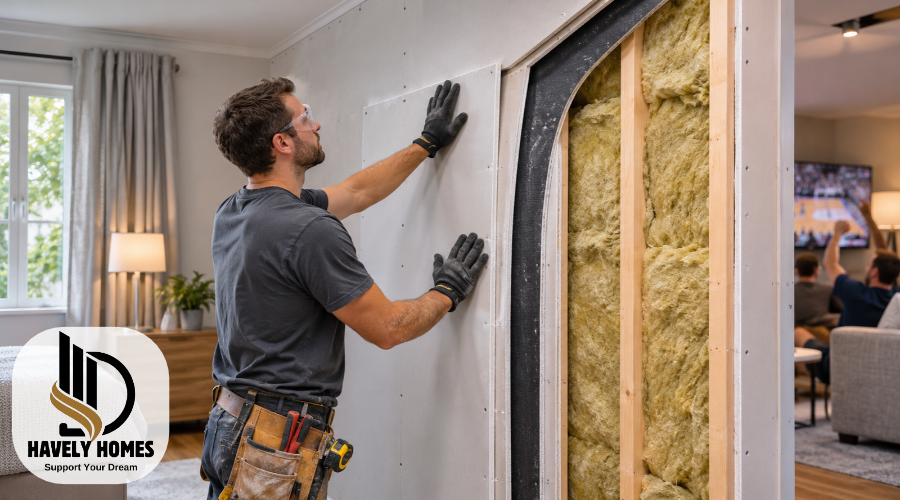
A television in the next room, conversations through a bedroom wall, or traffic outside can make an otherwise comfortable home feel noisy. If sound regularly interrupts sleep, work, or family time, improving the walls or ceilings may help.
Drywall with soundproofing is one option. Some products contain layers designed to reduce vibration, while ordinary drywall can become part of an effective sound-control system when combined with insulation, sealing, or other construction methods. Neither approach makes a room completely silent.
The right choice depends on where the noise comes from, whether you are renovating an existing room, and what you can spend. Understanding the materials and their limitations helps you avoid an expensive upgrade that tackles the wrong problem.
Quick Answer:
Drywall with soundproofing helps reduce noise travelling between rooms using thicker panels, damping materials, or layered construction. First, identify the noise source and check wall gaps, doors, and existing insulation before choosing a solution.
Quick-Guide Table
| Possible problem | What to check | Recommended action |
| Conversations heard through walls | Shared wall construction and insulation | Consider suitable acoustic drywall or an additional drywall layer. |
| Footsteps from upstairs | Whether noise comes through the floor structure | Consider a properly designed floor-ceiling soundproofing system. |
| Loud music or bass | Noise frequency and vibration paths | Seek an assembly designed for low-frequency sound control. |
| Sound leaking around openings | Gaps around doors, wall edges, and penetrations | Seal suitable gaps using compatible acoustic materials. |
| Existing drywall provides poor isolation | Wall condition, thickness, and construction | Compare approved retrofit panels or multilayer systems. |
| Moisture-damaged drywall | Visible stains, softness, or damp areas | Identify and repair moisture problems before upgrading. |
Helpful Steps Before Choosing Soundproof Drywall
- Identify the noise: Determine whether the main problem is conversation, television, traffic, music, or footsteps.
- Locate the sound source: Listen near shared walls, ceilings, doors, and windows.
- Inspect visible gaps: Check wall edges, door frames, and accessible openings without removing electrical fittings.
- Examine existing drywall: Look for cracks, moisture damage, or loose sections.
- Compare suitable materials: Review standard 5/8-inch drywall, acoustic panels, and compatible sound-damping systems.
- Check product instructions: Confirm whether the selected materials are approved for walls, ceilings, or existing surfaces.
- Plan the budget: Include materials, installation, finishing, and any necessary professional work.
What Is Drywall With Soundproofing?
Soundproof drywall is gypsum wallboard designed or installed to reduce the amount of sound travelling between spaces. The name is slightly misleading: its purpose is sound reduction, not perfect soundproofing.
Standard drywall consists mainly of a gypsum core faced with paper. Specialized acoustic panels may combine gypsum layers with a flexible, sound-damping material that limits vibration. Other systems use conventional drywall in multiple layers, sometimes with a damping compound between them.
These products are most useful where you want more privacy between bedrooms, a quieter home office, or less television noise entering a neighbouring room. They can also form part of a more involved home theatre wall.
Remember that the drywall is only one part of a wall. Studs, insulation, gaps, outlets, and adjoining building surfaces all influence how much noise reaches the other side.
Why Does Noise Travel Through Drywall Walls?
Noise can cross a wall in more than one way. Airborne sounds, such as speaking, barking, or music, make the wall surfaces vibrate. Some of that movement reaches the room next door. Sound can also pass directly through openings around pipes, outlets, or poorly sealed edges.
Impact noise behaves differently. A slammed door or a vibrating appliance can send movement through framing and connected structures. Even a well-insulated wall may transmit this kind of disturbance.
Before buying materials, listen for where the sound seems strongest. Notice whether it comes through a shared wall, under a door, near a vent, or from overhead. Check for obvious gaps and damaged trim without opening electrical fittings or walls.
This simple assessment matters. Adding expensive drywall to one wall may offer limited improvement when most of the noise is entering through a hollow door or travelling along the floor and ceiling.
How Soundproofing Drywall Reduces Noise
Effective sound control usually combines four ideas: mass, damping, absorption, and decoupling.
Mass makes a surface harder for airborne sound to move. A thicker sheet or an extra drywall layer can help, although additional weight alone has limits. Damping reduces vibration within a panel or between layers, using an engineered material such as a viscoelastic compound.
Absorption happens inside the wall cavity. Mineral wool or fiberglass insulation helps reduce sound energy in the enclosed space, but insulation alone cannot stop vibration travelling through studs. Decoupling reduces the direct mechanical connection between the drywall and framing. Properly designed isolation clips, channels, or separate framing can help achieve this.
These methods work together. For example, a second drywall layer may improve a basic wall, but adding suitable cavity insulation and carefully sealing its edges may produce a more useful overall system. The best combination depends on the existing construction.
Understanding STC Ratings and Realistic Soundproofing Results
Sound Transmission Class, or STC, is a number used to compare how well a tested wall or floor-ceiling assembly limits airborne sound. In general, a higher STC rating means better resistance to sounds such as ordinary conversation.
Crucially, an STC rating belongs to the complete tested construction, not to an individual drywall sheet. The same panel can perform differently depending on stud type, insulation, layers, and installation details. A manufacturer’s advertised number should therefore be checked against the assembly used in testing.
STC also has limits. Deep bass, heavy footsteps, and vibrations from equipment may remain noticeable even behind a wall with a respectable rating. Installation quality, doors, and sound bypassing the partition can further reduce the improvement you hear at home.
Use STC figures to compare similar, documented systems—not as a guarantee that a certain noise will disappear.
Best Drywall With Soundproofing: Types and Materials Compared
There is no single best drywall with soundproofing for every house. The most useful choice depends on the noise source, the wall you already have, and whether losing a little room space matters.
Regular drywall: Standard board is usually the simplest starting point. A second layer adds mass, but does not automatically create strong sound isolation. Soundproof drywall 5/8-inch options: Thicker conventional panels can be useful in tested multilayer systems, while some purpose-made acoustic panels are also available in this thickness. Check the exact product rather than assuming all 5/8-inch sheets perform alike.
Factory-damped panels: QuietRock drywall includes products engineered to limit vibration. Its 1/2-inch QuietRock 500 panel is marketed for residential noise control, but the manufacturer does not recommend that model for ceilings. Other QuietRock products have different construction and installation requirements.
Gold Bond SoundBreak XP offers acoustic gypsum panels for suitable walls and ceilings. Its thinner, 5/16-inch SoundBreak XP Retrofit board is specifically intended for application over existing gypsum walls, not ceilings.
Conventional board with damping compound: A suitable compound between two compatible rigid layers offers another approach. Compare the total materials, thickness, labour, and tested assembly performance before choosing between this and factory-damped drywall.
Adding Soundproofing to Existing Drywall Walls
If the existing drywall is sound and dry, you may be able to improve the wall without removing it. One common retrofit approach adds another gypsum layer over the current finish. A compatible damping compound may be used between layers when the selected system calls for it.
Purpose-made retrofit boards can be thinner. For example, Gold Bond’s SoundBreak XP Retrofit is designed to work over existing gypsum walls using the specified adhesive and screws. It requires full-wall coverage and correct orientation, so it is not simply a decorative panel you can attach wherever convenient.
Opening the wall may be more worthwhile if its cavity is empty, substantial defects are hidden, or you need a stronger isolation design. That creates more mess and cost but provides access for insulation and framing work.
Any overlay changes wall thickness. Plan for baseboards, door casings, electrical box extensions, and fittings. Repair leaks or damaged drywall first. Never cover damp, mouldy, or structurally unsound material merely to make a room quieter.
Drywall With Soundproofing for Ceilings and Upstairs Noise
A noisy upstairs room presents two different problems. Speech, music, and television are airborne sounds; footsteps and dropped objects create impact noise transmitted through the floor structure.
A suitable ceiling assembly may improve airborne sound isolation by combining approved drywall, insulation between joists, and an isolation system. For impact noise, improvements to the upstairs floor—such as an appropriate underlayment—may be particularly important. Drywall below cannot always solve a problem originating at the floor surface.
Besides STC, professionals may consider Impact Insulation Class (IIC), which describes a floor-ceiling assembly’s performance against impact sounds in standardized testing.
Ceilings also need careful attention to panel weight, framing support, fastening, light fittings, and any required fire-resistance rating. Not every soundproof wallboard is approved overhead: QuietRock 500 and Gold Bond’s 5/16-inch SoundBreak XP Retrofit are examples of products that should not be used for ceiling applications. Choose a documented ceiling assembly rather than adapting wall instructions.
Soundproof Drywall Installation: Planning and Key Steps
Good installation matters as much as the product label. Start by identifying the wall or ceiling construction, checking for moisture damage, and selecting a sound-control assembly suitable for that location. Read the current instructions for every panel, compound, sealant, and fastening system before work begins.
A practical installation plan follows these stages:
- Measure and prepare. Work out the area, allow for reasonable cutting waste, and move or protect furniture. Confirm that framing and existing surfaces are suitable.
- Address hidden work safely. Have a qualified electrician handle outlet or wiring modifications. Do not cut into unknown cavities or obstruct ventilation and required clearances.
- Install the specified layers. Follow the approved panel orientation, fastener schedule, attachment method, and any required damping-compound directions.
- Control sound leaks. Treat perimeters, permitted joints, and penetrations with products compatible with the assembly, without blocking vents or altering electrical equipment.
- Finish the surface. Tape, fill, sand, and paint as directed after installation.
Drywall sheets are heavy, especially overhead. Use suitable lifting assistance, eye protection, and dust controls. In older homes, disturbing paint or concealed materials may raise lead or asbestos concerns; arrange appropriate assessment before demolition. Fire-rated assemblies and complicated ceiling systems should be handled by experienced professionals.
Additional Materials That Improve Drywall Soundproofing
Drywall performs best when the surrounding construction does not undermine it. Acoustic sealant can help close appropriate gaps around the wall perimeter and certain penetrations. Sealing matters because even small openings can allow unwanted sound to bypass the main surface.
Mineral wool and fiberglass insulation absorb sound within stud or joist cavities. Neither substitutes for drywall, but both can be valuable parts of a designed assembly. Damping compounds reduce vibration between compatible rigid layers; they are not interchangeable with ordinary caulk or glue.
Resilient channels and isolation clips can reduce vibration transfer when installed correctly. Incorrect screws or rigid connections can defeat their intended purpose.
Consider the rest of the room too. A solid-core door, suitable weatherstripping, or a door-bottom seal may address a weakness that extra drywall cannot. Acoustic foam and decorative wall panels mainly reduce reflections inside a room; they are not a replacement for construction intended to block sound between rooms.
Drywall With Soundproofing Cost: Materials, Labour, and Budget
The cost of drywall with soundproofing is not just the price of one sheet. Your final bill depends on the selected assembly, wall area, local material prices, accessibility, and how much finishing or demolition is needed.
Standard drywall is generally less expensive per panel than engineered acoustic drywall. However, adding another layer of ordinary board may also require damping compound, more screws, extra labour, and adjustments to trim and electrical boxes. Factory-damped panels may cost more upfront while reducing the number of layers needed in some designs.
For a realistic estimate, compare the complete installed cost, including panels, insulation, sealant, fasteners, joint finishing, painting, delivery, waste removal, and any electrical work. Ceilings and walls with many openings can be more labour-intensive than a plain partition.
DIY may save some labour on simple, permitted work, but poor sealing or incorrect installation can waste that saving. Ask contractors for itemized quotes based on the same assembly so that the comparison is meaningful.
How to Choose and Where to Buy Soundproof Drywall
Start with the room’s actual problem. For a bedroom affected by nearby conversation, a well-sealed, insulated wall assembly may make sense. For a home office, check whether the door is the weakest point. Home theatres and loud music rooms often require more careful consideration of low-frequency sound and structure-borne vibration.
When comparing products, check panel thickness, weight, approved applications, installation instructions, and independently tested assembly data. A product that suits a wall may not be suitable for a ceiling, and a fire-resistant panel is not automatically a certified fire-rated system.
If you search for “soundproof drywall near me,” contact local building suppliers and ask whether they stock the exact model or can special-order it. Lowe’s lists QuietRock 500 in its drywall range, but store availability and pricing vary by location. Compare delivery costs and handling requirements, too.
Choose the system you can install correctly, not whichever package makes the boldest noise-reduction claim.
Common Soundproofing Mistakes and When to Hire a Professional
A common mistake is concentrating on drywall thickness while leaving obvious paths for sound. Unsealed edges, poorly treated wall penetrations, and gaps at doors may undermine otherwise good materials. So can installing insulation but overlooking direct structural connections that carry vibration.
Other mistakes include fixing isolation channels in a way that creates rigid bridges, assuming acoustic foam blocks neighbouring noise, or choosing a product solely because it has a high advertised STC number. Using wall-only panels on ceilings is another serious error.
Protect existing building performance. Do not substitute boards or change fasteners in a required fire-rated assembly without checking the approved design. Never seal over ventilation openings, interfere with recessed lighting clearances, or modify electrical boxes without appropriate expertise.
Call a qualified professional if work involves wiring, major demolition, concealed moisture, possible hazardous materials, load-bearing elements, or complex ceiling construction. An acoustic specialist can help when bass or structural noise continues despite basic improvements.
After the job, listen from different locations and check for remaining leakage paths before purchasing more material. Sometimes a smaller correction is more useful than another wall layer.
Conclusion
Drywall with soundproofing can make bedrooms, offices, and shared living spaces more comfortable, but the best results come from treating the entire wall or ceiling as a system. Additional mass, damping, insulation, isolation, and careful sealing each serve different purposes.
Start by identifying whether the problem is speech, music, footsteps, or vibration. Then compare tested assemblies, realistic costs, and the work needed in your home. Choosing a suitable product and installing it safely is far more valuable than expecting one sheet of drywall to make every sound disappear.
Frequently Asked Questions
Can Soundproof Drywall Be Painted Like Regular Drywall?
Yes. Most soundproof drywall can be finished with suitable joint compound, primer, and interior paint. Follow the manufacturer’s finishing instructions to achieve a smooth surface without affecting the intended installation.
Does Soundproof Drywall Work Without Insulation?
Soundproof drywall can reduce sound transmission without additional cavity insulation, depending on the wall assembly. However, suitable mineral wool or fiberglass insulation often improves overall performance when installed correctly.
Is Thicker Drywall Always Better For Soundproofing?
Not necessarily. Thicker drywall adds mass, but sound isolation also depends on damping, framing, insulation, and sealing. A properly designed acoustic assembly may perform better than simply adding thicker panels.
Can Soundproof Drywall Be Installed In Bathrooms?
Some acoustic drywall products may be suitable for certain bathroom locations, but moisture resistance varies. Check the manufacturer’s approved applications and use appropriate moisture-resistant materials where building requirements demand them.
Do You Need A Permit To Install Soundproof Drywall?
Permit requirements depend on local building regulations and the extent of the work. Simple surface upgrades may have different requirements from projects involving electrical changes, structural modifications, or fire-rated assemblies.
Disclaimer: The information on Havely Homes is provided for general educational purposes only and is not professional installation or safety advice. Always follow manufacturer instructions and applicable building regulations. Thermostat models and troubleshooting methods may vary, so consult the relevant manual or official support information. Electrical, wiring, gas, furnace, and complex HVAC work should be handled by qualified professionals. Havely Homes is not affiliated with Honeywell or its official support services. Our website is created solely to share helpful information with visitors, not to provide paid promotions or advertising.
