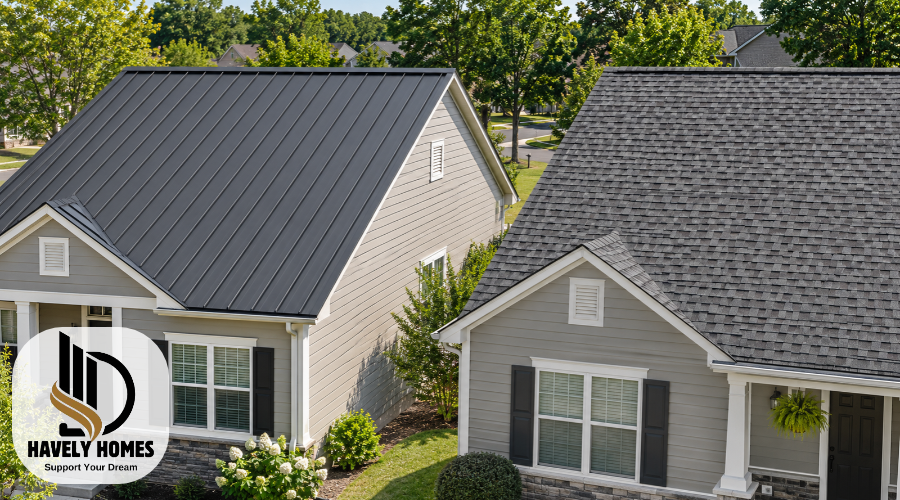
Asphalt shingles usually cost less upfront than metal roofing. Whether metal is worth the extra money depends on the type of metal roof, what it costs to maintain, and how long you plan to keep your home. If you move before a shingle roof needs replacing, you may never see the savings that come from a longer service life. If you stay for decades, a second shingle roof could narrow or erase the price difference.
This guide compares U.S. residential roof replacement costs in dollars. “Shingles” means asphalt shingles unless metal shingles are named separately. Start with the installed price for your actual roof, then compare what each option could cost during the years you expect to own it.
Quick Answer:
Asphalt shingles usually cost less upfront than metal roofing. First, check your measured roof area and compare installed quotes for the same work. Metal’s higher price may make sense if you plan to stay long term.
Quick-Guide Table
| Possible problem | What to check | Recommended action |
| Online estimates are much lower than your quote | Whether the estimate uses roof surface area and includes the same work | Use the roofer’s measured area and compare prices for the same scope. |
| One metal quote is much cheaper than another | Whether each bid specifies exposed-fastener panels, standing seam, or metal shingles | Ask both roofers to name the exact system, metal, and finish. |
| The total could rise after work starts | The decking allowance and the charge for replacing additional damaged decking | Ask for the unit price in writing before signing. |
| You’re unsure whether a roofing product meets California requirements | Your climate zone, roof slope, and how much of the roof will be replaced | Confirm the applicable cool-roof requirements with your local building department. |
| You notice missing shingles or a new ceiling stain after a storm | What you can see safely from the ground or inside your home | Document the visible signs and have a qualified roofer assess whether repair or replacement is needed. |
Steps to Compare Your Roofing Quotes
- Gather your roof records. Note the installation date, known leaks, and previous repairs. Share the same details with each roofer.
- Line up the bids. Check whether each includes tear-off, disposal, underlayment, flashing, and permits. Ask for any missing items to be priced separately.
- Read both warranties. Check who covers materials and labor, what exclusions apply, and whether coverage transfers if you sell.
- Compare costs over your expected ownership period. Add the upfront price and likely upkeep. Run a second estimate that includes another shingle replacement if it could fall within that period.
Metal vs Shingle Roofing Cost per Square Foot
HomeGuide’s 2026 U.S. cost guides give the following planning ranges for materials and installation labor. They show how the choice of roofing system changes the starting budget. Your final replacement quote will depend on local labor rates, roof conditions, and the work included.
| Roofing material | Estimated installed cost per sq. ft. |
| Basic 3-tab asphalt shingles | $3–$5 |
| Architectural asphalt shingles | $4–$6 |
| Corrugated sheet metal | $5–$12 |
| Metal shingles | $6–$14 |
| Standing seam metal | $9–$16 |
Roofers often price work by the roofing square, which equals 100 square feet of roof surface. A quote for $500 per square works out to $5 per square foot. The roof surface includes the sloped areas and overhangs, so a home’s listed floor area can give you the wrong budget. Ask each contractor to show the measured roof area and clarify whether the quoted quantity includes extra material for cuts and waste.
What Would Each Option Cost for a 2,000-Square-Foot Roof?
Multiply the installed rate by 2,000 square feet, or 20 roofing squares. For example, architectural shingles at $4 to $6 per square foot come to $8,000 to $12,000. Standing seam at $9 to $16 comes to $18,000 to $32,000. Comparing the low end of each range gives a $10,000 difference. Actual bids for the same home may show a different gap.
On that same roof, basic 3-tab shingles work out to $6,000 to $10,000, corrugated metal to $10,000 to $24,000, and metal shingles to $12,000 to $28,000. The overlap matters. A corrugated metal bid could come close to an architectural shingle bid, while standing seam may require a substantially bigger budget.
These examples cover roofing materials and installation labor at the listed rates. Keep tear-off, disposal, permits, and repairs to damaged decking as separate budget items until a contractor confirms what the bid covers. A useful estimate makes clear which charges are fixed and which may change once the old roof comes off.
How the Type of Shingle or Metal Changes the Price
Basic 3-tab shingles have a flatter, more uniform appearance. Architectural shingles use a layered design that gives the roof more depth and usually costs more. If wind performance is a priority, compare the rating and warranty terms for the exact shingles in each quote. The style name alone tells you little about the conditions attached to that rating.
Corrugated and ribbed metal panels often use screws that remain visible through the face of the panel. These exposed-fastener systems tend to be among the lower-cost metal options. Standing seam panels have raised seams and concealed fasteners. The panels and the work needed to fit and finish them usually bring the price up.
Stamped metal shingles offer a smaller-scale pattern that can resemble conventional shingles or tiles. Stone-coated steel is one option in this group. Ask the contractor to name the panel or shingle profile, the metal, and the finish. Those details help explain why two bids described simply as “metal roofing” can come in thousands of dollars apart.
Why Two Quotes for the Same Roof Can Differ
A steep roof can take longer to work on, and limited access can make it harder to move materials and haul away debris. Valleys and dormers add cuts and joints. Chimneys and other openings need flashing, which directs water away from vulnerable areas. These details can take considerable time on a metal roof with panels that must fit around several intersections.
The condition of the roof deck, the wood surface under the roofing, can also change the bill. A contractor may find damaged sections after removing the old roof. Ask how much decking replacement the estimate includes and what each additional sheet or square foot will cost. If the home has several layers of old roofing, confirm how many layers the tear-off price covers. A clear unit price lets you see the effect of extra work before you authorize it.
Metal vs. Shingle Roofing Costs in California
The Journal of Light Construction’s 2025 Cost vs. Value report put a modeled Los Angeles roof replacement at $36,417 for asphalt shingles and $62,069 for metal. The asphalt project alone specified 3,000 square feet of roofing, removal and disposal, and custom flashing around two skylights. That scope helps explain why the benchmark is higher than the smaller installation example above.
Use those figures as a Los Angeles reference for a defined project. To budget for your own home, get bids based on your city, roof measurements, and product choice. California’s energy code can also affect which roofing products qualify. Cool-roof requirements for a reroof can depend on the climate zone, the roof slope, and how much roofing you replace. Check with your local building department and ask the roofer to identify any required product ratings in the bid.
Life Expectancy, Maintenance, and Warranties
InterNACHI’s inspection guidance uses about 20 years for 3-tab asphalt, 30 years for architectural asphalt, and 40 to 80 years for metal roofing as broad planning estimates. The metal range covers different materials and systems. Installation quality, weather exposure, and upkeep can shorten the service life of any roof, so use these figures to compare scenarios and ask your contractor what is realistic for the system and location.
Exposed-fastener metal roofs need periodic professional checks of the screws and sealing washers according to the manufacturer’s guidance. Standing seam systems conceal the panel fasteners, though flashing and other details still need attention over time. With asphalt, ask how the roofer would handle an isolated damaged shingle and whether a matching product is likely to be available.
Read the manufacturer’s product warranty and the contractor’s workmanship warranty separately. Check who covers labor, whether coverage decreases with age, and what transfers if you sell. Use the expected service life for your ownership budget and the written warranty to understand which costs you might have to pay if a problem develops.
When Does a Metal Roof Make Financial Sense?
Compare both options over the same period. Suppose your local bids are $12,000 for architectural shingles and $22,000 for standing seam. For a 10-year stay, assume both roofs last through that period and allow an illustrative $500 in upkeep for either roof. Your totals would be $12,500 for shingles and $22,500 for metal, before any resale or insurance effects.
Now run the comparison over 35 years. Suppose the shingle roof needs one $12,000 replacement in today’s dollars, the metal roof lasts through year 35, and you budget $1,000 in total upkeep for each option. The comparison becomes $25,000 for shingles and $23,000 for metal. These are sample inputs. A later shingle replacement, a different maintenance bill, or a larger metal premium can change which option costs less.
That timing explains the debate on Reddit about whether to pay more for metal or keep the upfront savings. In this example, you pay the $10,000 metal premium today, while the second shingle bill may be decades away. If you would save or invest that money, or if the metal roof would require more borrowing, account for that in your comparison. Run the numbers once with a second shingle roof and once with the original shingles lasting through your planned ownership period.
Metal vs. Shingles in Hot Climates and Severe Weather
In a hot climate, compare the solar reflectance ratings for the exact colors and finishes you’re considering. Solar reflectance measures how much sunlight the surface reflects. Both reflective asphalt shingles and coated metal roofing are available. The effect on your cooling bill depends on factors such as the climate, attic insulation, and the performance of the roof you’re replacing.
For hail, ask for the impact rating of each proposed product. Metal can show dents while continuing to shed water, and impact-rated asphalt shingles are also available. In a high-wind area, ask how the proposed roof system is rated and how the installation will meet local requirements. Where wildfire exposure is a concern, confirm the fire classification of the roof as installed. The roof covering and the layers beneath it can both matter to that classification.
Will a Metal Roof Change Your Home Insurance Cost?
Send your insurer the product name and any test or rating documents for each roof before you sign a contract. Ask for the estimated premium with each option, whether the wind or hail deductible would change, and how the policy handles cosmetic hail damage. A policy may treat dents that only affect appearance differently from damage that stops the roof from keeping water out. Ask the insurer to confirm the terms in writing before including any savings in your budget.
California’s Safer from Wildfires program identifies a Class A fire-rated roof as a qualifying wildfire mitigation measure. Asphalt and metal products can both be part of Class A roofs. Ask what documentation your insurer needs and what premium change applies to your home. That gives you a dollar figure you can compare with the difference between the roofing bids.
How Roof Replacement Affects Resale Value
In the Journal of Light Construction’s 2025 national benchmark, the asphalt shingle project cost $31,871 and added an estimated $21,501 in resale value, recovering about 68% of its cost. The metal project cost $51,865 and added an estimated $25,972, recovering about 50%. Metal added more estimated resale value in dollar terms, while asphalt recovered a larger share of what the homeowner spent.
How much a new roof matters to a buyer depends on the local market and the condition of the existing roof. Replacing a roof that is already leaking or near the end of its service life may matter more to a sale than upgrading a sound roof to a more expensive material. If you expect to sell soon, ask a local real estate agent how buyers in your area have responded to similar roof replacements.
How to Compare Roofing Quotes Safely
Ask for itemized bids that use the same measured roof area and describe the work in enough detail to compare. Each bid should name the roofing product and say whether it includes removal, disposal, underlayment, flashing, permits, and a decking allowance. Check the workmanship warranty and who handles any permit. If a price is unusually low, ask the contractor to walk you through any work priced separately.
Keep your own checks at ground level. From a safe spot, you can look for missing shingles or visible storm damage and make a note of any ceiling stains you’ve noticed indoors. Have a qualified roofer inspect leaks, storm damage, or suspected decking problems. Ask whether the issue is confined to one area and can be repaired, or whether the condition of the rest of the roof makes replacement more practical. That assessment can change the project budget before you even choose a material.
Conclusion
Asphalt shingles usually make sense when keeping the upfront cost low is the priority. Metal may justify its higher price when you expect to own the home long enough for the longer service life to matter. The result depends on the specific system, the cost of upkeep, and when a replacement would fall within your ownership period.
Start with two itemized local bids for the same roof and scope. Compare what you would pay today, what each roof is likely to need while you own the home, and how a possible shingle replacement changes the total. Those figures give you a practical basis for choosing the roof that fits your home and budget.
FAQs
Does A Metal Roof Always Cost Twice As Much As Shingles?
The price difference depends on the system. Corrugated metal can come close to architectural shingles in some bids, while standing seam generally carries a larger premium. Compare quotes for the same roof and work.
How Long Do Metal Roofs And Asphalt Shingles Typically Last?
Broad planning estimates are about 20 years for basic 3-tab shingles, 30 years for architectural shingles, and 40 to 80 years for metal roofing. Installation quality, weather exposure, and maintenance affect actual service life.
Will A Metal Roof Lower My Home Insurance Premium?
It depends on your insurer, policy, and the specific roof’s ratings. Ask for a written premium estimate and confirm how the policy handles deductibles and cosmetic hail damage before counting on savings.
Which Adds More Resale Value, Metal Roofing Or Shingles?
In the 2025 national benchmark discussed in the article, metal added more estimated resale value in dollars, while asphalt recovered a larger share of its cost. Local buyers and the condition of your current roof also matter.
Is Metal Roofing Always Cooler Than Asphalt Shingles?
Both coated metal and reflective asphalt shingles can reduce solar heat gain. Compare the ratings for the exact products. Your climate, attic insulation, and existing roof also affect how much difference you may notice.
Disclaimer: Havely Homes was created to provide general information and does not engage in paid promotions or advertising. Roofing costs and conditions vary by home. Have a qualified roofer assess your roof. Thermostat controls and troubleshooting vary by model, so check your model manual or official support. Leave electrical, wiring, gas, furnace, and complex HVAC work to a qualified professional. Havely Homes is independent of Honeywell and provides no official Honeywell support.
