
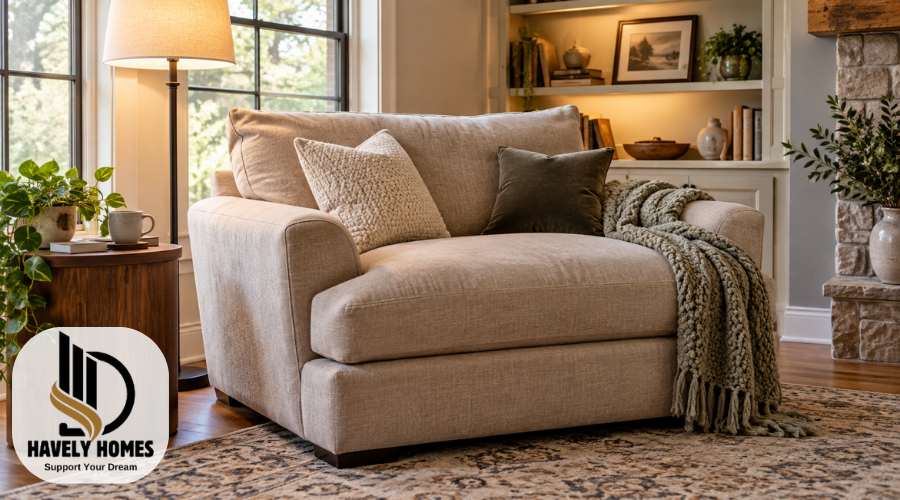
A chair and a half gives you more room than a typical armchair without taking up as much space as a full loveseat. Its wider seat can make it comfortable for reading, watching TV, curling up with a blanket, or simply relaxing when you prefer more personal space. The category includes everything from clean-lined accent chairs to deep lounge chairs, recliners, leather styles, and models paired with ottomans. Pasted text
One important thing to know is that “chair and a half” does not describe one fixed set of dimensions. Current models vary substantially. For example, West Elm lists an Andes chair and a half at 43 inches wide, while current Crate & Barrel examples range from 44.5 inches wide to as much as 58 inches. IKEA also sells a 1.5-seat armchair measuring 52 3/4 inches wide.
That difference makes measuring, comfort, upholstery, and room layout more important than the name alone.
Quick Answer:
A chair and a half is an oversized armchair with more sitting room than a standard chair but generally less seating than a loveseat. Check its exact dimensions, seat depth, comfort, and available room space before buying.
Quick-Guide Table
| Possible concern | What to check | Recommended action |
| Chair may be too large | Overall width, depth, and height | Measure the intended floor space before ordering |
| Seat may feel too deep | Manufacturer-listed seat depth | Choose a depth that suits your usual sitting position |
| Delivery may be difficult | Doors, hallways, stairs, and tight corners | Measure the complete delivery route |
| Ottoman may crowd the room | Combined chair and ottoman footprint | Mark both pieces on the floor before buying |
| Recliner needs extra room | Open or fully extended dimensions | Follow the manufacturer’s clearance requirements |
| Upholstery may be difficult to maintain | Material and care instructions | Choose upholstery that suits your household and cleaning needs |
Helpful Steps Before Buying a Chair and a Half
- Measure the width, depth, and height of the available space.
- Check the exact dimensions of the chair rather than relying on the product name.
- Compare seat depth, seat width, back height, and cushion firmness.
- Measure doors, hallways, stairs, and other parts of the delivery route.
- Allow additional floor space if you want an ottoman or reclining model.
- Review upholstery care instructions, especially in homes with children or pets.
- View or request a fabric sample when possible before choosing a color.
What Is a Chair and a Half?
A chair and a half is an oversized upholstered chair designed to give one person more sitting room than a standard armchair. Depending on the design, it may also be roomy enough for an adult and a young child or pet to sit together occasionally.
Think of it as furniture that sits somewhere between a conventional lounge chair and a loveseat in terms of usable space. It is still primarily a chair, but its wider frame gives you more freedom to change position, tuck up your legs, or sit with a pillow beside you.
Retailers do not always use exactly the same terminology. You may see similar pieces described as oversized chairs, 1.5-seat armchairs, wide-seat chairs, lounge chairs, or oversized accent chairs. IKEA, for example, currently uses the term “1.5-seat armchair” for its VISKAFORS model.
This flexibility is useful, but it also means you should never assume that two products called a chair and a half will have similar dimensions or feel the same when you sit in them.
Chair and a Half Size and Dimensions
There is no single universal chair-and-a-half size. Current products show just how much the dimensions can change from one collection to another.
For example, West Elm’s Andes Apartment Chair and a Half measures 43 inches wide and 39 inches deep. Crate & Barrel’s Wells version measures 44.5 inches wide and 34.5 inches deep, while its Lounge Deep model is 49 inches wide and 46 inches deep. The Axis chair and a half is even wider at 58 inches.
That is why overall width is only the beginning. Check:
| Measurement | Why It Matters |
| Overall width | Shows how much wall and floor space the chair needs |
| Overall depth | Helps determine how far it projects into the room |
| Seat width | Shows the actual usable sitting area |
| Seat depth | Affects whether the chair feels upright or lounge-like |
| Seat height | Influences how easy it may feel to sit down and stand up |
| Overall height | Matters around windows, shelves, and other furniture |
| Arm height | Can affect comfort and how the chair fits beside tables |
Arm thickness also matters. Two chairs can have almost identical overall widths but very different usable seat widths because one has broad padded arms and the other has slim track arms.
Do not rely on a generic size chart when ordering. Use the measurements for the exact model you are considering.
Where a Chair and a Half Works Best in the Home
A chair and a half is versatile enough to work in several areas of the home, provided the room has enough space around it.
In a living room, it can create a comfortable individual seat opposite or beside a sofa. It can also help balance a layout where one normal accent chair looks too small but another loveseat would make the room feel crowded.
A bedroom can be another good location, especially if you want a generous reading corner. Add a floor lamp and a small side table, and the chair becomes a separate place to relax without using the bed.
In a family room or media room, deeper styles can provide comfortable casual seating. A home library may benefit from a supportive version designed for longer reading sessions.
Larger chairs can also work in nurseries or other quiet sitting areas, but size should be considered carefully. A wide chair can quickly dominate a small room.
Leave clear walking routes around the furniture. The chair should not block doors, drawers, heating or cooling vents, or the natural path people use to cross the room.
Chair and a Half With Ottoman for Extra Relaxation
A chair and a half with ottoman can create a more relaxed lounge setup because the ottoman gives you somewhere to support your feet without choosing a reclining chair.
Some manufacturers make matching ottomans as part of a seating collection, while others sell coordinated chair-and-ottoman combinations. IKEA’s POÄNG range, for example, includes an ottoman intended to coordinate with the armchair.
An ottoman can also make the furniture arrangement more flexible because you can move it away when you want more open floor space.
However, measure the two pieces together. A chair that fits comfortably by itself may make a small room feel crowded once an ottoman sits in front of it.
Also compare proportions. An ottoman that is dramatically taller, lower, wider, or narrower than the chair may not provide the sitting position you expect. A matching model is often simpler because the manufacturer has designed the pieces to coordinate, but you should still confirm dimensions.
Chair and a Half Recliner vs. Standard Lounge Style
A chair and a half recliner combines an oversized seat with a reclining mechanism. Instead of placing your feet on a separate ottoman, the legrest becomes part of the chair.
Current manufacturers offer genuinely oversized reclining models. La-Z-Boy, for example, describes its Roman model as a reclining chair and a half. It measures 52.5 inches wide and 41 inches deep when closed and reaches 67 inches when fully extended.
That extended measurement is important. A recliner that fits easily against a wall when upright may need considerably more space when opened.
A standard fixed chair may be better if you want a simpler silhouette, fewer moving parts, or the freedom to use a separate ottoman. A recliner may suit someone who regularly wants to raise their legs while reading or watching television.
Reclining designs also differ. Current retailer listings include manual and power-operated models, so never assume that all chairs use the same controls or require the same clearance.
Always follow the specific manufacturer’s placement, operation, assembly, and electrical instructions for the model you own.
Popular Shapes, Including Round and Accent Styles
Not every oversized chair has the familiar square shape with straight arms.
Traditional designs may have rolled or padded arms and a substantial upholstered frame. Modern versions often use narrower track arms, lower backs, exposed legs, or cleaner lines.
A chair and a half round or curved design can bring a softer shape into a room filled with rectangular sofas, tables, and cabinets. Barrel-inspired chairs wrap the back and arms around the sitter, while other rounded models simply use curved corners or an arched back.
An accent chair and a half can serve two purposes: providing practical seating while also introducing color, texture, or an interesting shape.
Look beyond the outer silhouette, though. Large curved arms may reduce the actual seat width. A slimmer frame can sometimes offer more usable sitting space even when the overall chair is narrower.
Upholstery Choices: Fabric, Leather, and Everyday Practicality
Upholstery has a major effect on appearance, feel, maintenance, and how easily the chair fits into your existing interior.
Fabric gives you a wide range of textures and colors. Depending on the manufacturer, you may find smooth woven fabrics, velvet, chenille, performance upholstery, or textured materials.
A chair and a half leather can work especially well in traditional, modern, industrial, or warm contemporary rooms. Genuine leather and leather-look materials should not, however, be treated as if they require identical care.
Always check the care information supplied for the exact upholstery. Even fabrics that look similar can have different cleaning requirements. IKEA, for instance, provides product-specific care instructions for its chair covers, while La-Z-Boy notes that deeper upholstery cleaning depends on the cleaning code assigned to the chosen covering.
For a home with children or pets, consider how frequently the chair will be used, whether crumbs or pet hair are likely, and whether the fabric’s cleaning instructions suit your household.
Removable or reversible cushions can also be useful when offered, but do not assume a chair has these features unless they are listed by the manufacturer.
Choosing Colors Such as Brown or Green
Color can determine whether an oversized chair blends into the room or becomes a focal point.
A chair and a half brown can pair naturally with wood furniture, cream walls, beige rugs, black accents, and other earthy shades. Brown leather can create a more traditional or warm appearance, while brown fabric may feel softer and more casual.
A chair and a half green can work differently depending on the shade. Olive and moss tones often sit comfortably with wood and warm neutrals, while deep emerald or forest green can create a stronger accent.
Before choosing, look at the furniture already in the room:
- sofa color
- flooring
- wall paint
- curtains
- area rugs
- wood finishes
- metal finishes
When possible, order or view a fabric sample. Screen brightness, photography, and surrounding colors can make online upholstery appear different from how it looks in your home.
If you change your decor frequently, a neutral chair may be easier to restyle with cushions and throws. If the rest of the room is understated, a stronger accent color can give the seating area more personality.
Comfort Features Worth Checking Before You Buy
A big chair is not automatically a comfortable chair. Comfort depends on how the seat proportions and cushioning suit the person using it.
Start with seat depth. Deeper chairs can be appealing for curling up, but someone who prefers sitting upright with their feet on the floor may find an extremely deep seat less comfortable.
Current chair-and-a-half models demonstrate these differences. West Elm’s Andes model lists a 30-inch seat depth, while IKEA’s VISKAFORS 1.5-seat chair lists a seat depth of 23 5/8 inches.
Also consider cushion firmness. A soft, sink-in seat may feel inviting for lounging, while firmer support may suit someone who prefers a more upright posture.
Back height and shape matter too. Some chairs have a low modern back; others provide taller support. Arm height can affect how naturally your shoulders and elbows rest.
Where manufacturers provide details, check the cushion filling and suspension system as well. Different products may use foam, fiber, springs, or combinations of materials.
If you can visit a showroom, sit in the chair for more than a few seconds. Try the position you actually use at home—upright, curled up, reading, or reclining.
How to Measure Your Room Before Buying
Measuring the room before ordering can prevent one of the most frustrating furniture mistakes: discovering that the chair is technically beautiful but physically too large.
First, note the product’s exact width, depth, and height. Then mark approximately the same footprint on your floor. Painter’s tape can help you visualize the space without moving heavy furniture.
Walk around the marked area. Can you still reach the sofa? Does a door open fully? Can you pull out nearby drawers? Is the walkway comfortable?
Do not stop at measuring the final location. Check the entire delivery route, including:
- entrance doors
- hallways
- staircases
- elevators
- landings
- narrow corners
- bedroom or living-room doors
Some furniture manufacturers provide delivery-measuring guidance because the path into the home can be just as important as the available floor area. West Elm, for example, includes delivery-measurement information alongside dimensions for its upholstered seating.
For a recliner, use the manufacturer’s open or fully extended dimensions, not only the closed measurements. For a chair and ottoman, mark both pieces on the floor.
Shopping Smartly Across Different Retailers
Furniture terminology is not perfectly consistent, so shopping only for products carrying the exact words “chair and a half” can unnecessarily limit your search.
You may find comparable seating under names such as oversized chair, wide chair, lounge chair, 1.5-seat chair, or oversized accent chair.
This is especially useful when searching for a chair and a half IKEA option. IKEA currently lists the VISKAFORS as a “1.5-seat armchair” rather than using the exact American phrase “chair and a half.” At 52 3/4 inches wide, it illustrates why dimensions and seating proportions are more useful than product naming alone.
When comparing products, look at more than width and price. Check:
- seat dimensions
- frame and cushion information
- upholstery material
- cleaning instructions
- assembly requirements
- delivery measurements
- warranty details
- return conditions
Current collections also prove that the category is broad. Crate & Barrel currently lists chair-and-a-half models ranging from a 44.5-inch-wide Wells design to a 58-inch-wide Axis, as well as leather versions and deep-seat configurations.
The best choice is therefore not simply the largest or softest-looking chair. It is the one whose dimensions, support, material, and style make sense for your home.
Common Chair and a Half Buying Mistakes
One common mistake is assuming that every chair and a half is roughly the same size. Current manufacturer dimensions show that this is clearly not the case.
Another is measuring the room but forgetting the delivery route. A 50-inch-wide chair may look perfect beside your sofa but still be difficult to move through a narrow doorway or around a tight stair landing.
Do not choose seat depth based only on the idea that deeper is always more luxurious. Your height, posture, and preferred sitting position matter.
Ottoman buyers should remember the extra floor area needed in front of the chair. Recliner buyers need to consider the chair’s dimensions when extended.
Upholstery should not be selected only because it looks attractive in photographs. Consider care instructions and how the material suits daily household use.
Finally, avoid choosing color from a small online photograph when samples are available. Lighting and screens can alter how a shade appears.
Conclusion
A chair and a half can be a practical middle ground when a regular armchair feels too small but a loveseat is more seating than your room needs. Its wider seat can create a comfortable reading corner, living-room lounge spot, bedroom retreat, or relaxed family-room seat.
The most important point is not to shop by the name alone. Actual dimensions vary widely, and seat width, seat depth, arm design, cushion support, upholstery, and room layout all influence how well the chair will work in your home.
A recliner may suit someone who wants an integrated legrest, while a chair and a half with ottoman offers a more flexible setup. Leather, fabric, round designs, brown neutrals, and green accent styles can all work well when chosen to suit the room rather than simply following a trend.
Before purchasing, measure the intended location and the entire delivery path, check the exact manufacturer’s specifications, and think about how you actually like to sit. Those simple steps give you a much better chance of choosing a chair that looks right, feels comfortable, and fits naturally into your home.
FAQs
Is A Chair And A Half Big Enough For Two People?
It is mainly designed as roomy seating for one person. Some models may accommodate an adult with a child or pet, but dimensions vary, so check the usable seat width before buying.
Is A Chair And A Half Smaller Than A Loveseat?
Usually, yes, but there is no universal size standard. Some oversized models can be quite wide, so compare the exact measurements of the chair and loveseat you are considering.
Is A Chair And A Half Good For A Small Living Room?
It can work well when a standard chair feels too small but a loveseat takes up too much room. Measure the floor area and maintain comfortable walking space around the chair.
Should I Choose A Chair And A Half With An Ottoman?
An ottoman can make lounging more comfortable and offers flexible foot support. However, it requires additional floor space, so measure the combined footprint before choosing a matching set.
What Is The Best Upholstery For A Chair And A Half?
There is no single best material. Fabric, leather, and leather-look upholstery offer different appearances and care needs. Choose according to daily use and follow the manufacturer’s specific cleaning instructions.
Disclaimer: This article is provided for general informational purposes only and is intended to help readers understand chair-and-a-half sizes, styles, comfort features, materials, and buying considerations. Furniture dimensions, construction, upholstery, care instructions, reclining mechanisms, warranties, and delivery requirements can vary between manufacturers and individual models. Always check the exact product specifications, care instructions, assembly guidance, and manufacturer information before purchasing or maintaining furniture. HavelyHomes.com is an independent informational website and does not claim to represent, endorse, or be officially affiliated with any furniture manufacturer or retailer mentioned in the article.
