
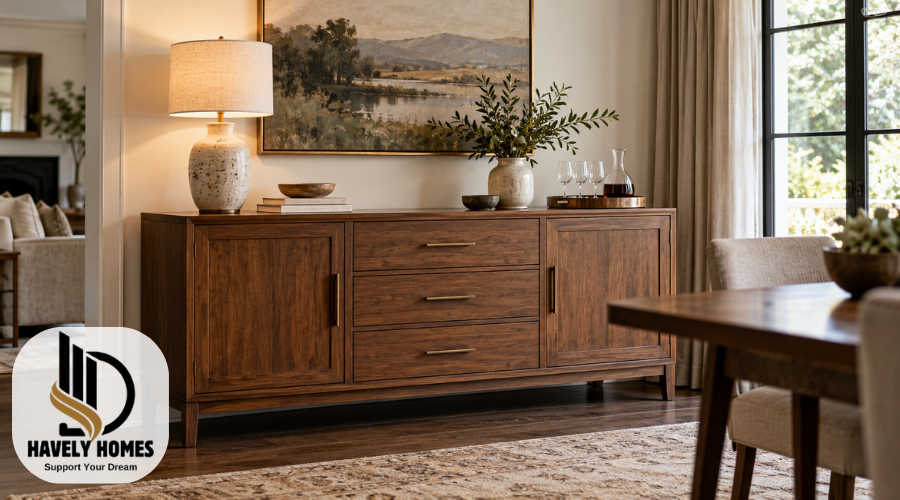
A credenza is a low, wide piece of storage furniture with a flat top and, in many designs, cupboards, shelves, drawers, or a combination of these features. It was traditionally connected with dining and serving, but today you can find credenzas in dining rooms, living rooms, home offices, entryways, and other parts of the home.
If you have been wondering what is a credenza, the easiest way to picture one is as a long cabinet that sits against a wall and gives you both enclosed storage and a useful surface on top.
The name can be confusing because similar furniture may also be sold as a sideboard, buffet, console, or storage cabinet. There is plenty of overlap between these terms, so the label alone does not always tell you exactly what you are buying.
Understanding the basic features, uses, and differences can help you decide whether a credenza is the right piece for your room.
Quick Answer:
A credenza is a low, wide storage cabinet with a flat top, often featuring doors, shelves, or drawers. It is commonly used in dining rooms, living rooms, offices, and entryways.
Quick-Guide Table
| Possible issue | What to check | Recommended action |
| Credenza is too large for the room | Wall width, furniture depth, and walking space | Measure the area before buying and allow enough room for movement |
| Storage does not fit your needs | Shelf height, drawer size, and cabinet layout | Choose storage based on the items you actually plan to keep inside |
| Doors or drawers cannot open fully | Nearby furniture, walls, and door clearance | Leave enough open space in front and around the credenza |
| Planning to use it for a TV | Manufacturer’s intended use, weight capacity, ventilation, and cable access | Use it for electronics only when the furniture is suitable and follow manufacturer guidance |
| Credenza feels overcrowded | Number and size of objects placed on top | Keep some open surface space and use only a few practical or decorative pieces |
Helpful Steps for Choosing a Credenza
- Choose its purpose first. Decide whether you need dining storage, office organization, living-room storage, or a display surface.
- Measure the space. Check the available width, depth, height, and surrounding walking area.
- Look inside the cabinet. Make sure shelves, drawers, and compartments suit the items you need to store.
- Check door and drawer clearance. Confirm everything can open without hitting nearby furniture.
- Consider the room’s style. Choose materials, proportions, and finishes that work naturally with your existing furniture.
- Check manufacturer guidance. If you plan to place a television or heavy equipment on it, confirm that the furniture is designed to support that use.
What Is a Credenza?
A credenza is generally a low and fairly wide storage cabinet designed to stand against a wall. Cambridge Dictionary describes a credenza as a low, wide cupboard, sometimes fitted with drawers, that is commonly used for storing items such as plates and glasses. It also lists sideboard as a synonym, which helps explain why the names are often used for similar furniture today.
Most modern credenzas have a broad, flat surface on top. Beneath that surface, you may find cabinet doors, adjustable or fixed shelves, drawers, open compartments, or several types of storage together.
There is no single design that every credenza must follow. One model may rest directly on a base, while another may have short or taller legs. Some are simple wooden cabinets, while others use glass, metal, veneer, painted finishes, or mixed materials.
The terms credenza cabinet and credenza table can also appear in furniture descriptions. A credenza cabinet usually emphasizes the enclosed storage part of the furniture. A credenza table normally still includes storage underneath, but its long top makes it useful as a serving or display surface.
Visually, if you see a long storage unit that is lower than a tall cabinet or bookcase and is positioned along a wall, there is a good chance it could reasonably be described as a credenza.
A Short History of the Credenza
The credenza has much older roots than the modern living-room and office versions seen today.
The Metropolitan Museum of Art has an Italian credenza dating from about 1440–1450. The museum describes this type of furniture as a functioning sideboard originally used in connection with preparing and serving food. Over time, it also became a place where valuable plates and vessels could be stored and displayed.
Historical records also show that credenzas and cupboards were well established in Italian interiors by the fifteenth century. The form developed from simpler furniture placed against walls and gradually became more substantial and decorative.
The word itself is Italian. In Italian, credenza can refer to belief as well as a cupboard or related piece of furniture.
You may come across a frequently repeated story that links the name to servants tasting food before it was served to important people. That story is part of the traditional explanation surrounding the term, but it should not be treated as the only certain account of the furniture’s origin. Museum evidence more clearly establishes the credenza’s historical role in serving, storing, and displaying dining objects.
As homes changed, the piece moved beyond that original dining function. Modern versions are now designed for many different rooms and storage needs.
What Is a Credenza Used For Today?
A modern credenza is useful because it combines hidden storage with a large surface without taking up the vertical space of a tall cabinet.
In a dining area, it can hold dinnerware, glasses, serving bowls, table linens, or special items that are not used every day. In a living room, the same type of furniture might store books, games, controllers, media equipment, or other items that would otherwise create visible clutter.
The top can also be useful for displaying a lamp, framed photographs, artwork, a vase, or a small group of decorative pieces. During meals or gatherings, a dining-room credenza can temporarily provide extra space for dishes and serving items.
Some homeowners also use credenzas for media equipment. This can work well when the furniture has suitable dimensions, ventilation, cable openings, and adequate strength. However, you should not assume that every credenza is designed to hold a television. The U.S. Consumer Product Safety Commission advises using furniture intended to support a TV and following the manufacturer’s instructions.
The best way to answer what is a credenza used for is therefore to think of it as flexible storage. Its exact job depends on the room and on what is inside the cabinet.
Before buying one, decide what you actually want to store. Someone keeping large serving dishes may need wide adjustable shelves, while a person organizing smaller items may benefit more from drawers and divided storage.
Using a Credenza in the Dining Room
The dining room is one of the most natural places for a credenza because it closely reflects the furniture’s traditional purpose.
A dining-room credenza can give you a dedicated place for plates, bowls, serving pieces, glassware, tablecloths, placemats, napkins, and other dining essentials. Items that are used only for holidays or special occasions can also be kept together instead of taking up space in kitchen cabinets.
The flat top adds another useful surface. Before a meal, you can use it to organize serving dishes or items waiting to go to the table. During a gathering, it can provide temporary space away from the main dining table.
This relationship with dining is not simply a modern decorating trend. Historical credenzas were used as sideboards for serving and storing food-related objects, according to The Metropolitan Museum of Art.
Placement matters. A credenza usually works best against a free wall where its doors and drawers can open without hitting chairs or other furniture. Leave enough clear space for people to move comfortably through the room, especially when dining chairs are pulled away from the table.
Also consider height. A piece that is comfortable for setting down serving dishes may be more useful than one chosen only because its appearance matches the room.
What Is a Credenza in an Office?
The word credenza is also commonly used for office furniture.
In an office, a credenza is usually a low storage unit placed against a wall, beside a desk, behind a desk, or in a meeting space. Instead of plates and glassware, it may hold files, paperwork, office supplies, equipment, or personal work items.
Office designs can include different features from dining-room furniture. For example, Steelcase offers office credenzas with combinations of open and closed storage, adjustable shelving, file storage, and integrated cable management. These features vary by product rather than being standard on every credenza.
This type of furniture can also make sense in a home office. A credenza can keep everyday supplies close to your desk while allowing the main work surface to stay clearer.
If you use printers, monitors, charging equipment, or other electronics on or inside a credenza, check the furniture manufacturer’s specifications first. Make sure the layout allows safe cable routing, ventilation where required, and enough support for the equipment.
An office credenza may look very different from an ornate dining-room version, but the basic idea remains similar: useful low storage combined with an accessible top surface.
Credenza vs Sideboard vs Buffet: What Is the Difference?
This is where furniture terminology becomes less exact.
A credenza, sideboard, and buffet can all describe low storage furniture with a flat top, particularly in or near a dining area. Cambridge Dictionary even lists sideboard as a synonym for credenza, while its definition of a sideboard describes a flat-topped storage piece used for items such as plates and glasses.
That means there is no reliable modern rule that will always separate one name from another. Manufacturers and furniture stores may use the terms differently.
Still, their traditional associations can help:
| Furniture term | Common association | Typical storage | Common placement |
| Credenza | Flexible low storage and display furniture | Cabinets, shelves, drawers, or mixed storage | Dining room, living room, office, entryway |
| Sideboard | Dining storage and serving | Cupboards and often drawers | Dining room or living area |
| Buffet | Dining storage and food serving | Cabinets, shelves, or drawers | Dining room |
| Console table | Narrow display or landing surface | Often little or no enclosed storage | Entryway, hallway, living room |
So, when considering what is a credenza vs sideboard, the answer is that the two categories overlap heavily. In many homes, the same piece could reasonably be called either one.
The same is true when comparing what is a credenza vs buffet. The word buffet often places more emphasis on dining and serving, while credenza is now widely used for storage furniture in several types of rooms.
When shopping, focus less on the label and more on width, depth, height, internal storage, materials, door clearance, and intended use. Those details will affect your home much more than whether the product page calls the piece a credenza, sideboard, or buffet.
Credenza Cabinet, Credenza Table, or Console?
Furniture names can become even more confusing when retailers use phrases such as credenza cabinet or credenza table.
A credenza cabinet generally refers to a credenza where enclosed storage is the main feature. It may have solid doors, sliding doors, drawers, or shelves hidden inside.
A credenza table is usually not a table in the same sense as a dining table. The term often draws attention to the broad top surface while storage remains underneath. For that reason, it is worth looking at the actual design rather than assuming the word table means open legroom below.
A console table is usually easier to distinguish. Consoles are often narrower and are designed mainly to provide a surface along a wall, behind a sofa, or in a hallway. Some include drawers or shelves, but many provide much less enclosed storage than a typical credenza.
If your main goal is to hide dishes, office supplies, games, electronics, or household items, a credenza-style cabinet may be more practical. If you mainly want a slim place for keys, lighting, decor, or a few everyday objects, a console may suit the space better.
The most useful approach is to look at what the furniture actually does rather than relying entirely on its product name.
How to Choose the Right Credenza for Your Home
Start by deciding where the credenza will go and what you need it to do. A dining-room piece may need room for large dishes and glassware. A home-office credenza might need files and cable access. A living-room version may be used for games, books, or media equipment.
Measure the available space before you shop. Check the width of the wall, but also pay attention to depth. A credenza that looks compact in a large showroom or online photo can project farther into a small room than expected.
Measure nearby doorways, furniture, and walking routes as well. If the credenza has hinged cabinet doors or deep drawers, make sure they can open fully without striking another object.
Think about storage before style. Useful questions include:
- Do you need wide shelves for large items?
- Would adjustable shelves give you more flexibility?
- Are drawers important for smaller belongings?
- Do you want everything hidden behind doors?
- Will you need access to electrical cables?
- Are there items that need ventilation?
Once the practical requirements are clear, consider appearance. Wood tones can add warmth, while painted, glass, or metal details can create a different look. Mid-century-inspired pieces often feature clean lines and raised legs, while traditional designs may use heavier proportions and more decorative details.
There is no single style that is best. The right credenza is one that fits the room, provides useful storage, and works with furniture you already own.
If you plan to place a television or heavy equipment on it, check the manufacturer’s stated use, dimensions, weight limits, and safety instructions. A low shape alone does not automatically make a credenza suitable as a TV stand.
Placement, Styling, and Common Mistakes
Once a credenza is in place, it is easy to overfill the top because the broad surface feels like extra storage. A better approach is to keep some open space so the furniture still looks intentional and remains useful.
You might place a lamp at one end, add artwork or a mirror above it, and use a tray or a few decorative objects to create balance. Plants can also work well where light conditions are appropriate. There is no need to fill every inch.
Pay attention to scale. Very small artwork can look lost above a long credenza, while oversized decor may make the arrangement feel crowded. The furniture should also feel visually balanced with nearby sofas, dining tables, chairs, or other large pieces.
Several practical mistakes are worth avoiding. Do not choose a unit so deep that it narrows an important walkway. Make sure doors and drawers have space to open. Avoid blocking heating or cooling vents, electrical outlets that need regular access, or other household features.
Safety matters too, especially in homes where children live or visit. The CPSC recommends securing furniture and televisions to help reduce tip-over hazards and following manufacturer instructions for proper anchoring. It also advises keeping tempting items that may encourage children to climb away from the tops of furniture.
Finally, do not buy a piece simply because it is labeled a credenza. Check the internal space. A beautiful cabinet with shelves that are too small for your belongings will not solve your storage problem.
Conclusion
So, what is a credenza? In simple terms, it is a generally low, wide storage cabinet with a useful flat top. Although it has strong historical links with dining and serving, the modern credenza can work in dining rooms, living rooms, offices, entryways, and other areas that need organized storage.
The differences between a credenza, sideboard, and buffet are not always strict. Their uses and designs overlap, and furniture sellers may apply the names differently. Instead of concentrating too much on terminology, look closely at the piece itself.
Consider the available space, the items you need to store, the type of shelves or drawers you want, and how the furniture will fit with the rest of the room. Measure carefully, follow the manufacturer’s safety guidance, and make sure any piece used for a television or electronics is designed for that purpose.
If those practical details suit your home, a credenza can provide useful storage while giving you a clean, versatile surface that works with many different decorating styles.
FAQs
Is A Credenza The Same As A Sideboard?
The terms often overlap, and some dictionaries treat sideboard as a synonym for credenza. Traditionally, sideboards are strongly associated with dining rooms, while modern credenzas are also commonly used in offices and living spaces.
Can A Credenza Be Used As A Tv Stand?
Some credenzas can hold televisions, but not every model is designed for that purpose. Check the manufacturer’s weight limits, dimensions, ventilation, stability, and cable-access guidance before using one for media equipment.
Where Should A Credenza Be Placed?
A credenza is commonly positioned against a wall in a dining room, living room, office, entryway, or hallway. Choose a location that leaves enough room for doors, drawers, and comfortable movement.
What Should You Store In A Credenza?
Storage depends on the room. A credenza may hold dinnerware, linens, books, office supplies, games, paperwork, or household items. Choose the internal layout according to what you actually need to organize.
Does A Credenza Have To Have Legs?
No. Credenza designs vary considerably. Some sit on short or tall legs, while others have a solid base or sit closer to the floor. The storage function matters more than one specific leg style.
Disclaimer: This article is provided for general informational purposes only and is intended to help readers understand credenzas, their common uses, placement, and furniture terminology. Designs, dimensions, weight capacities, materials, installation requirements, and safety instructions can differ between manufacturers and individual products. Always check the manufacturer’s specifications, assembly instructions, anchoring guidance, and intended use for the specific furniture you own or plan to purchase, especially before placing a television or other heavy equipment on it. For installation, wall anchoring, repairs, or other work you are not confident performing safely, consider using an appropriately qualified professional. HavelyHomes.com is an independent informational Home website and is not affiliated with, endorsed by, or an official support service for any furniture manufacturer or retailer mentioned in its content.
