
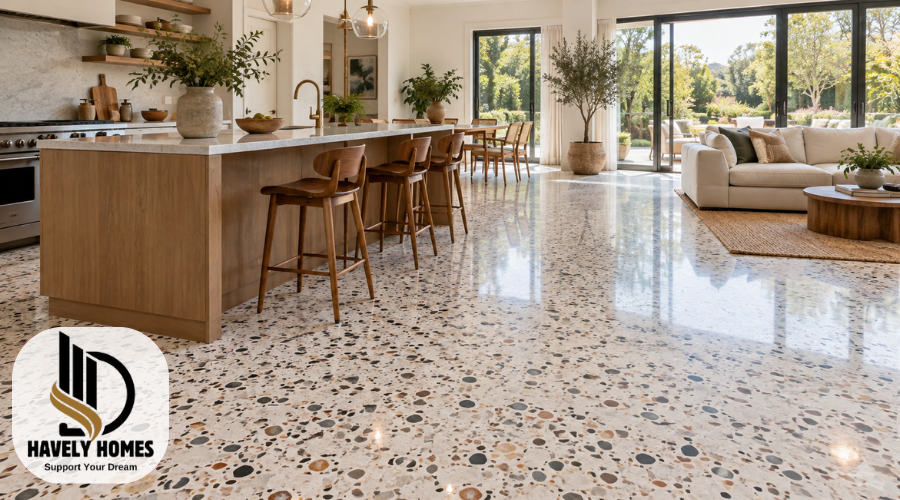
A terrazzo floor combines small pieces of decorative material with a cement-based or resin-based binder to create a hard, smooth surface. Depending on the design, the visible chips may include marble, granite, quartz, glass, or other suitable aggregates. The result can range from subtle and neutral to colorful and highly decorative.
For homeowners, however, choosing terrazzo involves more than picking a pattern. You also need to consider whether you want poured terrazzo or tiles, what type of binder suits the location, how much floor depth is available, the condition of the existing subfloor, installation costs, and future maintenance.
These details matter because terrazzo is not one single flooring system. Epoxy, cement-based, polyacrylate, bonded, and other systems can have very different thickness and installation requirements. Understanding those differences makes it much easier to decide whether terrazzo is a practical choice for your home.
Quick Answer:
A terrazzo floor is a hard composite surface made with decorative aggregates in a cement or resin matrix. Before choosing one, check the room, subfloor condition, available floor depth, moisture exposure, and installation requirements.
Quick-Guide Table
| Possible problem | What to check | Recommended action |
| Floor looks dull | Dirt buildup, worn finish, or condition of the existing sealer | Clean with a terrazzo-compatible product. If normal cleaning does not restore the finish, ask a terrazzo professional about refinishing or resealing. |
| Stains or marks appear | Whether the spill is recent and what cleaning products have already been used | Clean spills promptly with an appropriate neutral cleaner. Avoid experimenting with acidic, alkaline, or harsh household chemicals. |
| Cracks are visible | Whether cracks are isolated, widening, recurring, or associated with movement | Do not simply cover recurring or significant cracks. Have their cause assessed before restoration or patching. |
| Small areas look damaged or worn | Check whether damage is only at the surface or extends deeper into the floor | Minor surface deterioration may be restorable, while deep damage or loose areas should be inspected professionally. |
| Floor appears loose or separated | Look for hollow, raised, loose, or visibly separated areas without disturbing them | Avoid grinding or removing the area yourself. Ask an experienced terrazzo contractor to inspect possible delamination. |
Simple Terrazzo Floor Care Steps
- Remove loose dust, sand, and grit regularly with suitable sweeping, dust-mopping, or vacuuming equipment.
- Wipe up spills promptly instead of allowing liquids to remain on the surface.
- Use a cleaner specifically suitable for terrazzo, following its dilution and use instructions.
- Avoid vinegar, bleach, ammonia, strong acids, harsh alkaline cleaners, and abrasive cleaning products unless specifically approved for your floor.
- Keep entrance mats clean to reduce grit being tracked across the surface.
- If ordinary cleaning no longer restores the appearance, check the installed finish or ask a terrazzo professional whether refinishing or resealing is appropriate.
What Is a Terrazzo Floor?
Terrazzo is a composite flooring material. Decorative aggregates are mixed into a cementitious or resinous matrix, placed to form the surface, and then finished to reveal the chips and create a smooth appearance. The National Terrazzo & Mosaic Association (NTMA) recognizes several terrazzo systems based on the type of matrix and installation method.
Marble is traditionally associated with terrazzo, but modern systems can also include granite, glass and other decorative aggregates. Different combinations of matrix color, chip size and aggregate color give terrazzo its wide range of appearances.
It is also important to distinguish genuine terrazzo from terrazzo-look flooring. Some porcelain, ceramic, vinyl and other manufactured products simply reproduce the speckled appearance of terrazzo on their surface. They can still be useful flooring materials, but they do not have the same construction or restoration possibilities as a true terrazzo system.
This distinction matters when comparing prices, installation methods and maintenance advice. A cleaning or refinishing method intended for traditional terrazzo may not be appropriate for a porcelain or vinyl product that only looks like terrazzo.
Main Types of Terrazzo Flooring
Homeowners will most often come across cement-based terrazzo, resin-based epoxy terrazzo, poured systems and precast products such as terrazzo floor tile.
Poured-in-place terrazzo is installed over a prepared surface at the property. Depending on the system, the installer places the matrix and aggregate, allows the material to cure as required, and then grinds and finishes the surface. This can produce a visually continuous floor, although divider strips and movement joints may still be required.
Precast terrazzo tiles are manufactured before arriving at the property. They are installed as individual units, so the finished floor normally has visible joints between the tiles. Tiles can be useful in renovation projects where a full poured installation is not practical, although tile thickness, weight, substrate preparation and installation requirements still need to be considered.
Cement terrazzo itself is available in several systems. NTMA references include monolithic, bonded, sand-cushion and polyacrylate terrazzo, each designed for different project conditions. Resin-based epoxy is another major system.
There is no single type that is best for every house. A suitable choice depends on factors such as the existing structure, available floor height, moisture conditions, room location, desired appearance and whether the work is part of new construction or a renovation.
Terrazzo Floor Epoxy vs. Cement-Based Systems
A terrazzo floor epoxy system uses an epoxy resin as the matrix holding the decorative aggregates. One of its main practical advantages is its relatively thin profile. NTMA describes epoxy terrazzo as a nominal 1/4-inch or 3/8-inch resin matrix veneer placed over a properly prepared substrate.
Epoxy also gives designers considerable control over colors and patterns. Because it is lightweight compared with thicker cement systems, it may be useful in renovations and upper-floor applications where project conditions allow.
That does not mean epoxy is automatically the correct choice. NTMA’s epoxy specification is written for indoor, climate-controlled environments. The organization advises consulting its technical guidance for other uses.
Cement-based terrazzo includes several construction methods. Monolithic terrazzo, for example, uses a cement matrix placed directly over a suitable concrete slab. Bonded terrazzo includes an underbed, while sand-cushion terrazzo is a significantly thicker assembly with an underbed, reinforcement, isolation layer and sand layer.
Moisture and substrate conditions also influence system selection. A floor that works well in one room or property may be unsuitable in another. This is why the existing slab and environmental conditions should be evaluated before choosing between epoxy and cement-based terrazzo.
Understanding Terrazzo Floor Thickness
There is no universal terrazzo floor thickness. The required depth changes considerably depending on the system.
Thin-set epoxy is among the thinnest options. NTMA lists a nominal terrazzo topping of about 1/4 to 3/8 inch. Polyacrylate terrazzo is also relatively thin, with a nominal 3/8-inch topping. Monolithic cement terrazzo typically uses a 1/2-inch topping.
Thicker systems require much more space. Bonded terrazzo can have a total assembly of roughly 1.75 to 2.25 inches according to current NTMA technical information, while sand-cushion terrazzo is typically about 2.5 to 3 inches overall, including its terrazzo topping.
These differences are especially important during a renovation. Adding a thick floor can affect door clearance, thresholds, stairs, cabinetry and transitions into adjoining rooms. It may also add considerable weight.
For that reason, floor depth should be planned before finishes and doors are finalized. Structural suitability and substrate conditions should also be reviewed by an appropriate professional where necessary rather than choosing a terrazzo system on appearance alone.
Where Terrazzo Works Well in a Home
Terrazzo can work in many parts of a home, particularly where homeowners want a durable hard surface with a distinctive appearance. Entryways and hallways can benefit from its hard-wearing character, while living areas can use terrazzo as a strong visual feature.
A terrazzo floor kitchen can also make sense because the smooth surface is relatively straightforward to clean when it has been correctly installed and maintained. As with any kitchen flooring, food and drink spills should be cleaned promptly rather than allowed to sit on the surface.
Terrazzo works with many interior styles. Smaller chips and soft base colors can create a restrained appearance, while large aggregates or contrasting colors produce a more noticeable feature. Divider strips can become part of the design instead of being hidden.
When planning terrazzo for a kitchen, it helps to compare samples with cabinets, countertops, wall colors and adjoining flooring under the home’s actual lighting. A pattern that looks subtle in a small sample can appear much stronger across an entire room.
Bathrooms and other wet areas need additional thought. The selected system, waterproofing or substrate assembly where required, surface finish and slip resistance all need to suit the location. A highly polished appearance should not automatically be chosen for an area that frequently becomes wet.
Terrazzo is also a hard surface underfoot. That characteristic may be acceptable in an entry or kitchen but less appealing to someone looking for a soft, warm bedroom floor.
Terrazzo Floor Installation: What Homeowners Should Expect
Successful terrazzo floor installation begins with the surface below the finished floor. A poured finish cannot compensate safely for every problem in an existing slab.
Before installation, the contractor should assess the substrate for flatness, cracks, movement joints and other conditions that may affect the terrazzo. Moisture conditions may also need assessment, depending on the system and location.
NTMA emphasizes substrate preparation because a poured terrazzo surface depends on a suitable base. Its guidance notes that achieving the required flatness can involve grinding, filling or other preparation before the terrazzo itself is placed.
For poured terrazzo, the general process may include:
- Preparing and cleaning the substrate.
- Addressing required joints and approved crack treatments.
- Positioning divider strips where the design or floor construction requires them.
- Placing the selected terrazzo matrix and aggregate.
- Allowing the system to set or cure according to its specifications.
- Grinding and finishing the surface.
- Completing final cleaning and applying an appropriate sealer or finish where specified.
Exact procedures vary by terrazzo system, so this should not be treated as a DIY installation formula.
Terrazzo tiles follow a different process because individual precast units are installed rather than creating the entire finish in place. The installer still needs to consider the supporting surface, layout, joints, floor level and the requirements of the specific tile.
Joint planning is particularly important. NTMA explains that divider strips in bonded systems need to relate correctly to joints in the underlying concrete to help manage cracking.
Because mistakes can be difficult and expensive to correct after the floor is finished, complex poured terrazzo work is generally better handled by an experienced terrazzo contractor.
Terrazzo Floor Cost and What Changes the Price
There is no single terrazzo floor cost that accurately applies to every home. Prices vary by location and by the amount of work required before the visible floor is even installed.
Important cost factors include the size of the area, tile versus poured installation, terrazzo system, aggregate selection, number of colors, complexity of the design, divider strips, condition of the subfloor, repairs and removal of existing flooring.
Labor is also significant. A simple tile layout in a prepared room is very different from a custom poured floor requiring extensive slab correction, multiple colors and detailed patterns.
Current 2026 consumer cost guides show wide differences between projects and generally place poured installations above simpler tile work, although published estimates vary considerably. Both Angi and HomeGuide also identify material selection, preparation, design complexity and labor as major price factors.
For homeowners, local quotations are therefore more useful than relying on one nationwide average. Ask contractors to explain what their quotation includes, especially substrate preparation, existing-floor removal, material, finishing and any repair work.
Terrazzo can last a long time when correctly specified and maintained, but longevity should not be used to assume guaranteed financial savings. The practical comparison should include both the upfront installation cost and the maintenance expected for the particular floor.
Terrazzo Floor Cleaning and Everyday Care
Routine terrazzo floor cleaning is usually straightforward, but using the correct products matters.
Loose grit should be removed regularly because particles tracked in from outdoors can act like an abrasive when walked across the floor. Entrance mats can help reduce this problem.
For routine wet cleaning, follow the recommendations for your particular terrazzo system, sealer and finish. NTMA maintenance guidance recommends neutral-pH cleaning products for standard terrazzo finishes and warns that harsh cleaners and unsuitable sealers can damage the floor.
A simple care routine normally involves:
- Sweeping, dust-mopping or vacuuming loose debris with suitable equipment.
- Cleaning spills as soon as reasonably possible.
- Using a terrazzo-compatible cleaner according to its instructions.
- Rinsing where required so cleaner and loosened dirt are not left on the surface.
- Following the installer or sealer manufacturer’s maintenance instructions.
Do not assume that vinegar, strong acidic cleaners, highly alkaline products, abrasive powders, waxes or household polishing products are safe simply because they are commonly used on other surfaces.
Sealing requirements also vary. Cement-based terrazzo and different finishing systems may not have the same maintenance schedule as an epoxy floor. Rather than resealing according to an arbitrary calendar, check the recommendations for the installed system and sealer.
If you have moved into a home with terrazzo and do not know what finish is already on it, professional identification may be safer than experimenting with aggressive cleaners or coatings.
Terrazzo Floor Restoration: What Can and Cannot Be Fixed
Older terrazzo often does not need immediate replacement simply because it has become dull or worn. Terrazzo floor restoration can include cleaning, repairing damaged areas, grinding or refinishing, polishing and resealing, depending on the floor’s condition.
Professional assessment should come before cosmetic work if the floor has significant cracks. NTMA specifically advises investigating why a crack formed before repairing it because a patch may fail again if movement or another underlying condition continues.
Restoration can also involve replacing small damaged areas or patching previous repairs. However, matching an older floor perfectly can be difficult. Natural aggregates vary, and materials in the original installation may no longer be available in exactly the same color or size.
NTMA’s restoration guidance also notes that not every existing stain can necessarily be removed. Restoration expectations should therefore be realistic, particularly on an old floor with decades of wear, previous coatings or unknown repairs.
Get specialist help when you see extensive cracking, loose or delaminated areas, deep damage, continuing movement, widespread staining, or coatings you cannot identify. Grinding a floor without understanding its construction can create additional problems instead of fixing them.
Pros, Limitations, and Common Mistakes to Avoid
One of terrazzo’s main attractions is design flexibility. Aggregate size, matrix color and layout can be adjusted to create anything from a quiet neutral floor to an elaborate decorative surface. Genuine terrazzo can also be refinished and restored in many situations instead of automatically being replaced when the surface becomes worn.
Routine maintenance can be simple when the correct finish and cleaning products are used. Terrazzo also works well in areas where homeowners want a solid, hard flooring surface.
There are trade-offs. Terrazzo installation can have a higher initial cost than many common residential flooring choices, particularly when extensive substrate preparation or custom detailing is involved. Poured systems require specialist skill, and thicker cement assemblies may simply be impractical in an existing house.
It is also a hard surface, which may feel less comfortable underfoot than wood, cork or carpet. Cracks in the supporting structure, poor joint planning, moisture problems or unsuitable preparation can affect the finished floor.
Common mistakes to avoid include choosing terrazzo only from a small color sample, failing to account for finished floor height, ignoring cracks in the existing slab, using unsuitable cleaners, and assuming every terrazzo system can be installed in every location.
Another mistake is confusing genuine terrazzo with a terrazzo-look material. A terrazzo-pattern porcelain tile may be an appropriate choice for a project, but it should be evaluated and maintained as porcelain rather than as traditional terrazzo.
Most importantly, do not select the installation system based only on appearance. Substrate condition, room use, floor depth, moisture exposure and maintenance requirements are equally important parts of the decision.
Conclusion
A terrazzo floor can give a home a durable, distinctive and highly customizable surface, but good results depend on choosing a system that suits the property rather than simply choosing a favorite pattern.
Start by considering where the floor will be installed and what lies underneath it. Then compare poured terrazzo with tiles, check the available floor depth, understand how the selected system handles moisture and movement, and consider both installation and long-term care costs.
For straightforward daily maintenance, use products and methods that are compatible with the specific terrazzo and finish. For new poured installations, major restoration, structural cracking, moisture concerns or an existing floor of uncertain construction, getting advice from an experienced terrazzo professional can prevent expensive mistakes.
The best terrazzo choice is ultimately the one that fits the room, the building conditions, the maintenance you are comfortable with and the overall renovation budget—not simply the option that looks best in a showroom sample.
FAQs
Is Terrazzo Flooring Suitable For A Kitchen?
Yes, terrazzo can work well in kitchens when the correct system and finish are installed and maintained properly. Spills should be cleaned promptly, and cleaning products should be compatible with the terrazzo and its sealer.
What Is The Difference Between Epoxy And Cement Terrazzo?
Epoxy terrazzo uses a resin matrix and can form a relatively thin flooring system. Cement terrazzo uses a cement-based matrix and comes in several installation systems with different thickness, weight, and substrate requirements.
How Thick Is A Terrazzo Floor?
Thickness depends on the system. Thin epoxy terrazzo may have a nominal topping around 1/4 to 3/8 inch, while some cement-based assemblies require substantially more total floor depth.
Can Terrazzo Be Installed During A Home Renovation?
It can be suitable for renovations, but the existing subfloor, available floor height, structural conditions, moisture, transitions, and chosen system must be considered before installation begins.
Can An Old Terrazzo Floor Be Restored?
Many terrazzo floors can be cleaned, repaired, refinished, or polished, depending on their condition. Deep damage, delamination, recurring cracks, difficult stains, or unknown previous coatings should be evaluated by an experienced professional.
Disclaimer: This article is provided for general home-information purposes only. Terrazzo materials, installation systems, thicknesses, substrates, sealers, finishes, and maintenance requirements can differ between properties and products. Always follow the specifications and care instructions provided by the terrazzo manufacturer, installer, sealer manufacturer, or other relevant supplier. Homeowners should avoid attempting structural repairs, significant crack repairs, grinding, resurfacing, or complex restoration without appropriate experience. If a terrazzo floor has major cracks, loose or delaminated areas, moisture problems, significant damage, or an unknown existing coating, consider having it inspected by a qualified flooring or terrazzo professional before repair work begins. havelyhomes.com provides general informational content and is not a terrazzo manufacturer, installer, contractor, or official representative of any flooring brand or trade organization.
