
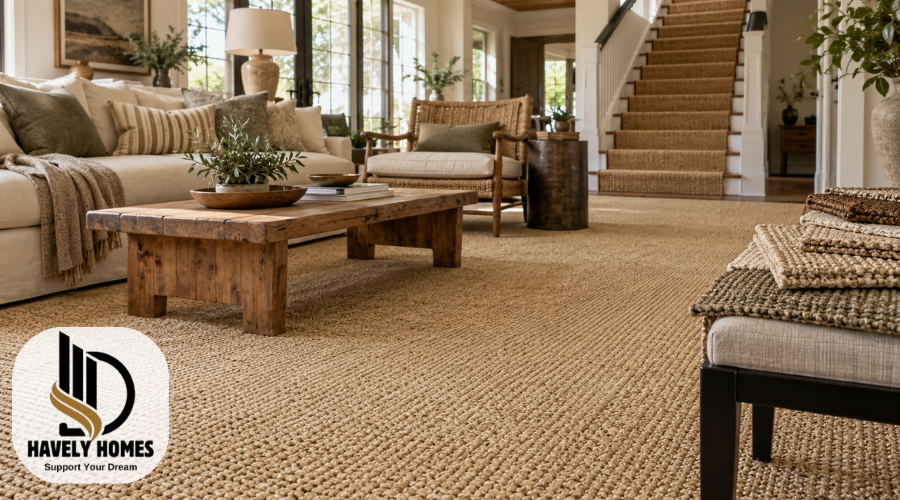
Sisal carpet is a natural-fiber floor covering made from sisal, a strong fiber taken from the leaves of the Agave sisalana plant. Sisal has long been used for products such as rope, cordage, and woven goods because its fibers are tough and useful for demanding applications.
In the home, sisal is valued for its natural texture, woven appearance, and understated colors. You can find it as wall-to-wall carpet, stair runners, and area rugs. However, it is not the right flooring for every room. Natural sisal is firm underfoot and sensitive to excess moisture, so the way you use and maintain it matters.
This guide explains where sisal works well, what to know before installing it, how it performs on stairs and in homes with cats, how to clean it safely, and how it compares with seagrass.
Quick Answer:
Sisal carpet is durable natural-fiber flooring with a firm, woven texture. Before choosing it, check the room’s moisture exposure, the product’s actual fiber content, and the manufacturer’s cleaning and installation guidance.
Quick-Guide Table
| Possible problem | What to check | Recommended action |
| Water or spill marks | Look for recent spills, damp footwear, or excess cleaning moisture | Blot fresh moisture promptly and follow the manufacturer’s approved stain-care instructions |
| Pulled or damaged fibers | Check for pet scratching, snagging, or heavy wear | Avoid cutting or gluing fibers without product-specific repair guidance; seek professional repair for significant damage |
| Rug moves underfoot | Check the backing and whether a suitable rug pad is being used | Use a compatible rug pad or anti-slip solution recommended for the rug and floor type |
| Worn traffic areas | Inspect hallways, entrances, and other frequently used sections | Increase routine vacuuming and consider professional advice if wear becomes severe |
| Changes after cleaning | Check whether steam, excess water, or an unsuitable cleaner was used | Stop the cleaning method and consult the flooring manufacturer or a natural-fiber cleaning professional |
| Damaged edges or seams | Inspect borders, joins, and wall-to-wall transitions | Avoid DIY adhesive repairs unless approved for the product; arrange professional repair when needed |
Helpful Steps Before Buying Sisal Carpet
- Confirm that the product is genuine sisal or identify the exact fiber blend.
- Consider how much moisture and spill risk the room has.
- Feel a sample to make sure the firm texture is comfortable for your household.
- Check whether the product is approved for your intended room or stairs.
- Review backing, underlay, and installation requirements.
- Read the manufacturer’s cleaning instructions before buying.
- Compare a physical sample in your room under both daylight and artificial lighting.
What Is Sisal Carpet?
Sisal fiber comes from the leaves of Agave sisalana. After the useful fiber is separated and processed, it can be made into yarn and woven into different products, including floor coverings.
In flooring, the word “sisal” can describe several different formats.
Sisal carpet usually refers to woven flooring that may be installed across a larger floor area.
Sisal rugs are finished pieces that sit on top of an existing floor. They can be moved, replaced, or repositioned more easily.
Sisal runners are long, narrow pieces commonly used in hallways or on stairs.
Sisal-blend flooring combines sisal with another fiber, such as wool. A blend may feel different from a 100% sisal product, so always check the fiber content instead of judging by appearance alone.
The same caution applies to products advertised simply as “natural fiber,” “woven,” or “sisal-look.” These descriptions do not necessarily mean the product is made entirely from sisal.
Natural sisal commonly has a visible woven texture and earthy shades such as beige, tan, brown, and similar neutral tones. Exact color, feel, weave, and backing vary between products.
The Main Pros and Cons of Sisal Flooring
One of sisal’s main advantages is the strength of its natural fiber. Its toughness has made it useful for rope and other fiber products as well as flooring.
From a design point of view, sisal adds texture without needing a bold pattern. It can work with modern, coastal, rustic, traditional, and minimalist rooms because the woven surface adds visual interest while remaining relatively neutral.
Routine care can also be straightforward when the flooring stays dry. Regular vacuuming helps remove loose dirt before it settles deeper into the weave.
The disadvantages are just as important. Sisal can absorb moisture, so liquid spills, wet cleaning, and very damp conditions require care. Manufacturer guidance for natural-fiber rugs warns against saturating sisal because excessive moisture can cause staining or unwanted dimensional changes.
Sisal is also not a plush carpet. It normally feels firmer and rougher underfoot than soft wool or many synthetic carpets. That texture may be exactly what one homeowner wants and uncomfortable for another.
Because it is a natural material, small variations in color and texture can also occur. These differences are part of the character of natural flooring rather than necessarily being defects.
In simple terms, sisal can be a good fit for dry rooms where you want a firm, textured natural surface. It may be less practical where frequent spills, wet cleaning, or a very soft feel are priorities.
Where Sisal Carpet Works Best in the Home
Sisal generally makes the most sense in dry indoor spaces where moisture can be controlled.
Living rooms, hallways, home offices, and some bedrooms can all be suitable, depending on the specific product. Dining rooms may also work, but homeowners should think realistically about food and drink spills before choosing a large permanent installation.
Some manufacturers sell sisal carpet specifically rated for bedrooms, dining rooms, living rooms, halls, and stairs. That does not mean every sisal product is approved for all of those spaces, so check the specifications for the exact flooring you plan to use.
Moisture-prone areas deserve more caution. A bathroom, wet basement, or another room where flooring may regularly become damp is usually a poor match for ordinary natural sisal unless the manufacturer specifically states otherwise.
Entryways need a case-by-case decision. A sheltered entrance where shoes are normally dry is different from a doorway that regularly receives rainwater, snow, mud, or wet footwear.
Think about how the room is actually used. Foot traffic, spill risk, pets, children, comfort expectations, and cleaning habits matter more than how attractive a flooring sample looks in a showroom.
Sisal Carpet Wall to Wall: What to Consider
Sisal carpet wall to wall covers most or all of a room instead of sitting loosely on the floor like an area rug. It can create a clean, continuous look, but it also requires more planning.
Before buying, consider the condition of the subfloor, accurate room measurements, seam locations, transitions into other flooring, edge finishing, door clearance, and the type of backing or underlay required.
These details are product-specific. One sisal carpet may have a latex backing and require a particular fitting system, while another may have different instructions. For example, a current Crucial Trading 100% sisal product lists a latex backing and specific suitability and installation information for that product.
Professional measuring can be useful because woven natural flooring is less forgiving of mistakes than a small loose rug. Professional installation is especially worth considering when the room has complex corners, multiple seams, steps, or detailed transitions.
Also remember that wall-to-wall flooring is a bigger commitment if a spill or moisture problem occurs. An area rug can often be removed or replaced more easily, while permanently installed carpet may require a more involved repair.
Is Sisal Carpet a Good Choice for Stairs?
Sisal carpet for stairs can create a neat, textured look, and some sisal products are specifically rated by their manufacturers for stair use.
A stair runner covers the center portion of each step while leaving some of the stair surface visible at the sides. Fully carpeted stairs cover a much larger part of the tread and riser.
Whichever style you prefer, check the exact product before installation. Look at the weave, backing, edge treatment, stair dimensions, and manufacturer’s stated suitability.
Secure fitting is especially important on stairs. Flooring that shifts, wrinkles, lifts at an edge, or is poorly attached can become a trip hazard.
Stair installation can also be more demanding than fitting a flat room. The material has to follow treads, risers, landings, turns, and edges correctly. If you do not have experience installing carpet securely on stairs, professional fitting is the safer choice.
Do not assume that any sisal rug or carpet can automatically become a stair runner simply because it is made from sisal. Use a product intended for that application.
Sisal Carpet and Cats
Cats make sisal an interesting choice for homeowners because sisal is also widely used on scratching posts.
Scratching is a normal cat behavior, and veterinary guidance notes that different cats prefer different materials and scratching positions. Sisal is one of the materials many cats may choose.
That means sisal carpet for cats is not automatically scratch-proof. In fact, a cat that enjoys scratching a sisal post may also show interest in a sisal floor covering.
A useful approach is to provide dedicated scratching surfaces that suit your cat’s habits. Some cats prefer vertical posts, while others prefer horizontal pads. Matching the material, height, position, and orientation to the cat’s preference can make the approved scratching area more attractive.
Before installing sisal in a pet home, think about more than scratching. Claws may pull or disturb fibers, while urine, vomit, or other accidents introduce moisture and staining concerns.
A removable sisal rug may therefore be less risky than wall-to-wall sisal in a room where pet accidents are likely. It gives you more flexibility if part of the flooring becomes badly damaged.
Sisal should not be treated as a guaranteed way to stop cats from scratching furniture or other household surfaces.
Sisal Rugs vs. Wall-to-Wall Sisal Carpet
Sisal rugs offer many of the same visual qualities as installed sisal carpet but with more flexibility.
A rug can be moved between rooms, replaced if badly damaged, or taken away entirely if your needs change. This can make it practical for renters or homeowners who want to try sisal before committing to a full installation.
Wall-to-wall sisal gives more complete coverage and can make a room feel visually unified. However, fitting takes more work, and dealing with stains or damaged sections can be harder.
Rugs also come with different edge finishes and backing systems. Do not assume every rug has a non-slip backing. Check the product details and use a compatible rug pad when recommended for the rug and the floor underneath.
Current Home Depot listings, for example, show 100% sisal rugs in multiple sizes, shapes, constructions, and styles. This variety is a reminder to compare the individual product rather than treating all sisal rugs as identical.
Sisal Carpet vs. Seagrass Carpet
Sisal and seagrass carpet are both natural-fiber flooring options, but they come from different plants and have different surface qualities.
Sisal has a noticeable fibrous texture and can be offered in different weaves and colors depending on the product.
Seagrass flooring is made from woven seagrass fiber. Retail and manufacturer descriptions commonly note that it has a smoother surface and a slight natural sheen. Because seagrass fiber is less porous than sisal, it can also react differently to everyday spills.
However, that does not make seagrass waterproof. Cleaning guidance for natural seagrass rugs still warns against saturation and recommends controlling moisture carefully.
When comparing the two, consider texture first. If you like a drier, more pronounced woven feel, sisal may appeal to you. If you prefer a somewhat smoother surface, you may prefer seagrass.
Also compare the room conditions, expected traffic, likelihood of spills, available weaves, and the care instructions for the exact product. Neither material is automatically the best choice for every home.
How to Clean and Maintain Sisal Carpet
Regular vacuuming is one of the most useful ways to care for sisal.
Natural-fiber care guidance commonly recommends a strong-suction vacuum without a rotating beater bar or brush that could disturb the woven fibers. Always follow your own carpet manufacturer’s instructions if they differ.
If a spill happens, deal with it promptly. Blot the liquid with a clean, absorbent cloth instead of rubbing it into the fibers. Continue removing moisture as gently as possible, then follow the stain-treatment instructions supplied with your flooring.
Avoid treating sisal like an ordinary synthetic carpet. Natural-sisal care instructions warn against steam cleaning, wet shampooing, and other methods that saturate the material. Excess moisture can contribute to staining, distortion, or changes in the flooring.
Do not apply a household carpet cleaner simply because it worked on another rug. First check whether the product is approved by your sisal manufacturer. If the instructions recommend testing a cleaner, try it in a hidden area before using it more widely.
For widespread staining, uncertain discoloration, or a cleaning job beyond the manufacturer’s homeowner-care guidance, contact a cleaner who has experience with natural-fiber floor coverings.
Common Sisal Carpet Problems and Practical Checks
Sisal flooring can develop problems over time, especially when it is exposed to moisture, heavy wear, or unsuitable cleaning.
Common concerns include liquid marks, stained areas, pulled fibers, worn traffic paths, damaged borders, loose rug edges, and changes in shape or appearance after getting wet.
If you notice a problem, begin with simple checks. Look for the source of any moisture. Read the product’s care label or manufacturer’s instructions. Inspect the backing and edges. If the problem began after cleaning, stop using that cleaning method until you confirm that it is appropriate.
Small marks may be manageable with the manufacturer’s approved spot-cleaning method. A pulled fiber, damaged seam, large stain, or badly affected section may need repair or professional assessment.
Avoid improvising with scissors, glue, large amounts of water, harsh scrubbing, or unknown cleaning chemicals. A repair method that works on one carpet construction may damage another.
For area rugs, also check whether the rug is moving underfoot. If it slips, review the manufacturer’s recommendations for a suitable rug pad or backing system.
How to Choose and Where to Buy Sisal Carpet
A good buying decision starts with the product details, not just the color.
Before ordering, check:
- the actual fiber content
- whether it is a rug, runner, or wall-to-wall carpet
- the weave and underfoot texture
- the backing and underlay requirements
- whether it is approved for stairs or your intended room
- the manufacturer’s cleaning instructions
- the exact measurements you need
- whether samples are available
A sample can be especially valuable with sisal because photos do not fully show its texture. Place the sample in your room, look at it in natural and artificial light, and walk on it if the sample size allows.
If you search for sisal carpet near me, local flooring stores and specialist showrooms may let you compare samples in person. That can make it easier to judge texture, color, backing, and weave before paying for a large installation.
You can also compare natural-flooring specialists, carpet retailers, and major home-improvement stores. For example, Home Depot currently lists numerous rugs filtered as 100% sisal, including area rugs and runner shapes. Inventory, sizes, pricing, and store availability can change, so check current listings for your location rather than relying on an older recommendation.
If you are deciding where to buy sisal carpet, compare more than price. Look at return conditions, installation support, samples, product specifications, and care instructions.
Most importantly, do not assume a product is real sisal because the description says “natural,” “woven,” or “sisal-look.” Read the material specification.
Is Sisal Carpet Right for Your Home?
Sisal can be an excellent choice when its strengths match the way your household actually lives.
Start with moisture. If the room frequently becomes wet or requires regular wet cleaning, natural sisal may create more maintenance problems than it solves.
Next, think about spills. A quiet home office presents a different risk from a dining space used daily by young children.
Comfort also matters. If you want a soft, cushioned floor for bare feet, sitting, or children’s play, you may prefer another material or a sisal blend with a softer fiber.
Pets deserve consideration too. Cats may be attracted to the fibrous surface, and pet accidents can be difficult on moisture-sensitive natural flooring.
Finally, decide whether you need a rug or permanent installation. A rug gives you more flexibility, while wall-to-wall sisal can provide a more finished, continuous appearance.
Sisal is most likely to suit someone who enjoys natural texture, prefers a woven look, and is comfortable following material-specific care instructions.
If you need something that tolerates frequent soaking, aggressive cleaning, or very soft underfoot comfort, another flooring type may be easier to live with.
Before committing to a large wall-to-wall installation, compare physical samples in the room where the carpet will actually be used.
Conclusion
Sisal carpet can bring natural texture, structure, and warmth to a home, but choosing it successfully depends on understanding the material rather than selecting it for appearance alone.
Pay attention to moisture exposure, comfort, pets, traffic, cleaning needs, and installation requirements. Check whether the product is genuinely sisal, read the manufacturer’s care guidance, and confirm that it is approved for the room or stairs where you want to use it.
A removable rug may be the best option for one household, while wall-to-wall sisal may suit another. Neither choice is automatically better. The right decision is the one that matches the room, the way your household uses it, and the level of maintenance you are comfortable providing.
FAQs
Does Sisal Carpet Change Color Over Time?
Natural fibers can show some variation in shade and appearance. Sunlight, wear, moisture, and cleaning can also affect how flooring looks, so follow the manufacturer’s care guidance and check samples before installation.
Can I Put Furniture Directly On Sisal Carpet?
Usually, normal household furniture can sit on suitable sisal flooring, but heavy pieces may leave impressions or affect the weave. Check the flooring manufacturer’s recommendations and use appropriate furniture protection where advised.
Can Sisal Carpet Be Used With Underfloor Heating?
It depends on the exact carpet, backing, installation method, and heating system. Check the flooring manufacturer’s technical specifications and your heating-system guidance before installing sisal over underfloor heating.
Is Sisal Carpet Suitable For Allergy-conscious Homes?
Sisal is a natural plant fiber, but allergy needs differ between people. Regular vacuuming helps control ordinary household dust, while anyone with specific allergies should consider their own sensitivities and cleaning requirements.
How Long Does Sisal Carpet Last?
There is no single lifespan for every sisal carpet. Longevity depends on product quality, installation, foot traffic, moisture exposure, pets, cleaning methods, and maintenance.
Disclaimer: This article provides general information about sisal carpet, rugs, installation considerations, and routine care. Products vary in fiber content, backing, construction, approved uses, and cleaning requirements, so always check the manufacturer’s instructions for the exact flooring you own or plan to buy. The thermostat, Honeywell, electrical, gas, furnace, and HVAC disclaimer points provided in the request do not apply to an article about sisal carpet and have therefore not been presented as flooring advice. For carpet installation or repairs beyond normal homeowner care, especially complex stair fitting, seams, subfloor problems, or significant damage, consult an experienced flooring professional.
