
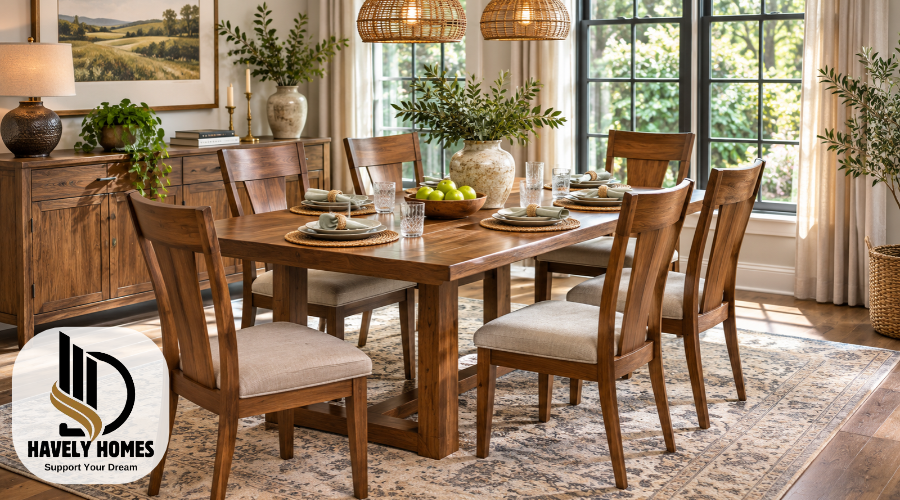
A dining room is more than a place to eat. It is where families share meals, guests gather, and everyday conversations happen. Choosing the right dining room sets can make these moments more comfortable while improving the appearance and usefulness of your home.
However, finding suitable dining furniture involves more than choosing an attractive design. The table must fit your available space, provide enough seating, and work well with your daily routine. Materials, chair comfort, construction quality, and budget also influence your decision.
Whether you need a compact table for four, a larger arrangement for eight, or a flexible design for occasional visitors, understanding your options makes shopping easier.
This guide explains dining set sizes, shapes, materials, styles, and practical buying considerations to help you create a comfortable and functional dining area.
Quick Answer:
Dining room sets usually include a table with matching chairs or benches. Choose the right set by checking your room dimensions, seating needs, table shape, materials, chair comfort, and available budget.
Quick-Guide Table
| Possible problem | What to check | Recommended action |
| Dining table is too large | Room measurements and available walking space | Choose a smaller or extendable table. |
| Not enough seating | Number of regular diners and occasional guests | Select a suitable 4-, 6-, or 8-person arrangement. |
| Chairs feel uncomfortable | Seat height, depth, back support, and legroom | Choose chairs that fit the table and provide comfortable support. |
| Dining area feels crowded | Table shape, chair placement, and surrounding furniture | Consider a round, compact, or space-saving arrangement. |
| Furniture is difficult to maintain | Tabletop material, finish, and upholstery | Choose materials that suit your cleaning routine. |
| Table or chairs feel unstable | Joints, legs, fittings, and assembly instructions | Stop using unstable furniture and correct the problem according to manufacturer guidance. |
| Dining set exceeds the budget | Total price, delivery charges, and assembly costs | Compare complete costs before purchasing. |
Helpful Steps: How to Choose the Right Dining Room Set
- Measure your dining space: Record the room dimensions and allow enough space for chairs and comfortable movement.
- Decide how many seats you need: Consider everyday household members and occasional visitors.
- Choose a suitable table shape: Compare rectangular, round, square, and oval tables based on your room layout.
- Select practical materials: Consider durability, appearance, cleaning requirements, and household activities.
- Check chair comfort: Compare seat height, back support, legroom, and upholstery.
- Review construction quality: Check materials, fittings, stability, and manufacturer specifications.
- Compare the complete cost: Include delivery, assembly, warranties, and any additional seating before making a final decision.
What Are Dining Room Sets, and What Do They Include?
A dining room set is a coordinated furniture collection designed for eating and gathering. Most sets include a dining table with matching or complementary chairs. Some arrangements feature benches instead of individual chairs.
Dining furniture is commonly sold in several configurations.
- 3-piece dining set: Usually includes one table and two chairs.
- 5-piece dining set: Typically provides one table and four chairs.
- 7-piece dining set: Commonly includes one table and six chairs.
- 9-piece dining set: Usually consists of one table and eight chairs.
However, these descriptions are not universal. A six-piece collection might contain a table, four chairs, and one bench. Larger furniture packages may include storage cabinets or other coordinated pieces.
Always check the product description to understand exactly what is included.
Buying a complete set makes coordinating furniture easier because the pieces are designed to work together visually. It may also simplify shopping compared with selecting individual items.
However, purchasing separately provides greater freedom to choose different chair styles, materials, and seating arrangements. The better option depends on your preferences, space, and budget.
Choosing Dining Room Sets for 4, 6, or 8 People
Seating capacity is one of the first decisions when choosing dining furniture. Consider how many people regularly eat together rather than focusing only on occasional gatherings.
Dining room sets for 4
Dining room sets for 4 work well for couples, smaller families, and households with limited space.
Most include a table with four chairs. Square, round, and compact rectangular tables are common choices.
A four-person arrangement can also provide a useful space for homework, hobbies, or occasional home working.
Dining room sets for 6
Dining room sets for 6 suit larger households and people who regularly welcome guests.
A typical arrangement includes a rectangular table and six chairs, although combinations with benches are also available.
Many rectangular six-person tables measure approximately 150–180 cm in length, but actual seating comfort depends on their design.
Dining room sets for 8
Dining room sets for 8 are useful for bigger families, frequent gatherings, and spacious dining areas.
These arrangements often feature longer rectangular or oval tables. Some include eight individual chairs, while others combine chairs with benches.
Before selecting 6 chairs dining room sets or 8 chairs dining room sets, check the available space around each seat.
As a general planning guide, allowing approximately 50–60 cm of table edge per person can help, although wider chairs may need additional room.
For households that entertain occasionally, an extendable table may be more practical than permanently keeping eight seats around a large table.
How to Measure Your Space Before Buying a Dining Room Set
Accurate measurements help prevent overcrowding and uncomfortable furniture arrangements.
Start by measuring the length and width of your dining area. Include the distance between nearby walls, cabinets, doorways, and other furniture.
Next, check the table’s dimensions.
Table length and width determine the surface area available for eating. For round tables, diameter is the important measurement. Height affects how comfortably chairs fit underneath.
Many standard dining tables measure approximately 74–76 cm high, although individual products vary.
Space around the table is equally important.
Allowing approximately 75–90 cm between the table edge and surrounding furniture is a useful starting point for pulling out chairs. Busy walkways may require considerably more space, particularly when people need to pass behind occupied chairs.
Remember that a table fitting inside the room does not automatically mean the seating arrangement will work comfortably.
Before buying, mark the proposed table position on the floor with removable tape. Then allow room for the chairs to move backwards.
Check whether cabinet doors can open fully and whether people can reach nearby areas without squeezing between furniture.
For extendable tables, measure the space needed when the tabletop is fully opened.
Dining Table Shapes and Their Best Uses
The shape of a dining table influences seating arrangements, movement, and the overall appearance of a room.
Rectangular dining tables
Rectangular tables are particularly suitable for longer dining rooms. They provide seating along both sides and sometimes at each end.
They are practical for larger families and can work well with benches.
Round dining tables
Round tables create a welcoming arrangement because everyone faces towards the centre.
Their curved edges can make movement easier in certain compact spaces. However, larger round tables still require considerable floor space.
Square dining tables
Square tables are useful for four-person arrangements, particularly in square rooms or smaller dining areas.
They offer balanced seating and can sometimes sit against a wall when fewer seats are needed.
Oval dining tables
Oval tables combine the length of rectangular designs with softer, rounded ends.
They can provide a less angular appearance while accommodating several people.
Table legs also matter. Corner legs may limit seating positions, while some pedestal bases provide greater flexibility. Always check the actual legroom.
Dining Room Set Materials: Durability, Appearance, and Maintenance
Dining room furniture comes in several materials, each offering different benefits and maintenance requirements.
Solid wood
Solid wood provides natural grain patterns and a warm appearance. Common options include oak, pine, acacia, and other timber species.
The hardness, finish, and construction influence durability. Some solid wood surfaces can be refinished, although this depends on their treatment.
Wood can react to moisture and temperature changes, so suitable care remains important.
Wood veneer and engineered wood
Wood veneer consists of a thin natural wood layer applied over another material, such as plywood or engineered board.
It provides a genuine wood appearance, often at a different price from solid timber.
Engineered wood products also include particleboard and MDF. Their durability depends on construction, surface protection, and moisture exposure.
Damaged veneer or laminated surfaces may be difficult to repair.
Glass
Glass tables create a visually open appearance and can complement contemporary interiors.
However, fingerprints and marks may be more noticeable. Edges, thickness, and glass specifications should be checked carefully.
Metal
Metal is commonly used for dining table frames and chair legs.
Different metals and protective coatings offer varying levels of strength and corrosion resistance.
Stone and stone-look surfaces
Natural stone offers distinctive patterns but can be heavy and may require specific maintenance.
Stone-look laminates and engineered surfaces provide alternative appearances, although their performance varies.
Choose materials according to everyday use, cleaning requirements, construction quality, and available budget rather than appearance alone.
Popular Dining Room Set Styles for Different Homes
Dining furniture should complement the room without necessarily matching every other item.
Modern dining room sets
Modern dining room sets often feature simple shapes, smooth surfaces, and understated colours.
Glass, metal, wood, and mixed materials are commonly used to create a clean appearance.
Mid-century modern
Mid-century-inspired furniture typically features streamlined shapes, tapered legs, and warm wood tones.
These designs can complement both contemporary and vintage-inspired interiors.
Farmhouse and rustic
Farmhouse dining furniture often highlights visible wood grain, substantial tabletops, and traditional shapes.
Rustic designs may include textured surfaces, distressed finishes, or trestle-style supports.
Traditional
Traditional dining sets commonly feature decorative details, curved chair backs, and classic wood finishes.
They can suit formal dining rooms or homes with established traditional décor.
Minimalist and Scandinavian-inspired
These styles generally focus on practical shapes, lighter finishes, and simple construction details.
They can help create an uncluttered dining area.
When coordinating furniture, consider your flooring, wall colours, lighting, and existing cabinets. Complementary tones and materials often create a more natural appearance than trying to match everything exactly.
Extendable Dining Room Sets: Flexible Seating Without Permanent Extra Size
Extendable dining room sets are useful when everyday seating needs differ from occasional gatherings.
An extendable table has a mechanism that increases its usable surface area. Different designs achieve this in different ways.
Removable-leaf tables use additional sections that are inserted when required. Butterfly-leaf designs commonly store a folding extension within the table.
Drop-leaf tables feature hinged sections that can be raised or lowered depending on the available space.
Some designs use sliding or other integrated extension systems.
The main advantage is flexibility. A household can use a smaller table during ordinary meals and increase seating space when guests arrive.
However, an extended table still requires enough surrounding clearance.
Before purchasing, check the closed and extended dimensions, available legroom, and recommended seating capacity.
Also consider where removable leaves will be stored and whether the extension mechanism is easy to operate.
Follow the manufacturer’s instructions when extending or closing the table, and check that all sections are securely positioned before use.
Dining Chairs and Benches: Choosing Comfortable Seating
Comfortable chairs are just as important as a well-sized dining table.
Wooden chairs can be practical for everyday meals because their surfaces are often straightforward to clean.
Upholstered chairs provide padding and softness, which some people prefer during longer meals. However, fabric may require more attention when spills occur.
Mixed-material chairs combine features such as wooden frames with padded seats.
Chair dimensions deserve careful consideration.
A standard dining chair commonly has a seat height around 43–48 cm. Depending on the table’s construction, approximately 25–30 cm between the seat and underside of the table can be a useful comfort guide.
Check the actual measurements rather than relying only on standard figures.
Counter-height and bar-height dining arrangements use taller tables and seating, so ordinary dining chairs may not be suitable.
Backrest shape, seat depth, and armrests also influence comfort.
Benches offer an alternative to individual seating and may suit informal family dining. Some can slide beneath compatible tables when not needed.
However, benches generally provide less individual back support unless specifically designed with backrests.
For households with young children or pets, consider stable construction, practical surfaces, and upholstery that can be maintained easily.
Space-Saving Dining Room Sets for Small Homes
Small dining areas benefit from furniture that supports daily activities without blocking movement.
Compact round or square tables can work well in apartments and smaller kitchens.
A rectangular table may be suitable for a narrow room, particularly when positioned carefully.
Drop-leaf furniture provides flexibility because unused tabletop sections can remain folded.
Similarly, a small extendable table can accommodate occasional visitors without occupying its largest footprint every day.
Benches that fit beneath the table may also reduce clutter.
In an open-plan home, the dining arrangement can help define the eating area without requiring separate walls.
Position furniture where people can comfortably move between the kitchen, seating area, and nearby doors.
Avoid filling every available corner with chairs or additional storage.
The goal is not necessarily to choose the smallest possible furniture, but to find a practical balance between comfort, seating capacity, and usable floor space.
How to Check Dining Room Set Quality Before Buying
A dining set should feel stable, comfortable, and suitable for regular use.
Start by examining the materials and construction details.
Check whether the table uses solid wood, veneer, engineered board, metal, or a combination of materials.
Look at how the legs connect to the frame and whether the design provides adequate support.
For chairs, examine the frame, joints, seat construction, and backrest.
If shopping in person, gently test whether the furniture feels stable on a level surface. Avoid products with noticeable movement or poorly fitted components.
Check the manufacturer’s stated weight limits where available.
Tabletop finishes also deserve attention. Consider whether the surface can tolerate everyday cleaning and the type of use expected in your household.
When shopping online, read the full specifications rather than relying only on photographs.
Customer reviews can provide useful information about assembly, comfort, and reported problems. However, individual experiences may differ.
Warranty conditions and available replacement parts can also help when comparing furniture.
Smart Buying Tips and Common Mistakes to Avoid
A thoughtful buying decision considers the complete cost and long-term usefulness of dining furniture.
Start by setting a budget that includes the table, seating, delivery, and any necessary assembly.
Compare similar products carefully because lower prices do not always mean better value.
Before ordering, complete these practical checks:
- Confirm the number of chairs and other included pieces.
- Check the complete table and chair dimensions.
- Review materials, finishes, and cleaning requirements.
- Measure delivery access, including doors, hallways, and stairs.
- Check assembly instructions and required tools.
- Read delivery charges, return conditions, and warranty information.
One common mistake is choosing furniture based mainly on photographs. A large table may appear attractive online but overwhelm a smaller dining area.
Another mistake is overlooking chair comfort. An attractive chair may be unsuitable if its seat feels too narrow or its height does not match the table.
Also avoid assuming that a high price always guarantees superior construction.
Some furniture requires careful assembly to remain stable. If the item is particularly heavy, complicated, or beyond your ability to assemble safely, professional furniture assembly may be worthwhile.
Cleaning, Caring for, and Maintaining Your Dining Room Set
Regular maintenance helps dining furniture remain attractive and functional.
Cleaning methods depend on the materials and protective finishes.
For finished wooden furniture, a soft cloth is often suitable for routine dusting. A slightly damp cloth may help remove everyday marks when permitted by the manufacturer.
Dry the surface afterwards and avoid leaving standing water.
Glass tabletops can be cleaned using suitable products and soft, non-abrasive cloths. Avoid materials that could scratch the surface.
Metal frames generally benefit from regular dust removal and cleaning appropriate to their finish.
Stone and engineered surfaces may require specific cleaners, so always follow the product’s care guidance.
For upholstered seating, check the fabric cleaning instructions before applying water or cleaning solutions.
Placemats, coasters, and suitable heat protection can help reduce everyday surface damage.
Avoid placing very hot cookware directly onto furniture unless the manufacturer confirms that the surface can tolerate it.
Protect wood and other sensitive materials from prolonged moisture exposure and harsh cleaning chemicals.
Periodically inspect furniture for loose fittings, damaged legs, and changes in stability.
If a chair or table becomes unsafe, stop using it until the problem is properly addressed.
With appropriate care, a suitable dining set can continue supporting everyday meals and gatherings for years.
Conclusion
Choosing the right dining room set involves balancing comfort, appearance, available space, and practical household needs.
Start with accurate room measurements and the number of people who regularly need seating. Then compare table shapes, chair comfort, construction materials, and maintenance requirements.
Whether you prefer modern furniture, traditional wooden designs, or flexible extendable tables, focus on how the arrangement will function in your home.
Take time to review product specifications, quality, and total costs before making a decision.
The best dining room set is not necessarily the largest or most expensive. It is one that fits comfortably into your home, supports your everyday routine, and suits your personal style and budget.
Frequently Asked Questions
Is It Better To Buy A Complete Dining Room Set Or Separate Pieces?
A complete dining room set makes coordinating furniture easier. Buying pieces separately offers more flexibility in style, comfort, and materials. The better choice depends on your space, preferences, and budget.
Can I Mix Different Dining Chairs With One Table?
Yes, mixing dining chairs can create an attractive, personalised arrangement. Choose chairs with compatible seat heights and proportions. Coordinating colours, materials, or design details can help maintain a balanced appearance.
Are Wooden Dining Room Sets Suitable For Homes With Children?
Wooden dining sets can work well in family homes when they have stable construction and appropriate finishes. Consider rounded corners, easy-to-clean surfaces, and regular maintenance when choosing furniture for children.
Should I Place A Rug Underneath My Dining Room Set?
A dining room rug is optional. It can add warmth and define the dining area, but it should be large enough to accommodate chairs when pulled out and easy to maintain.
How Long Should A Dining Room Set Last?
There is no fixed lifespan for a dining room set. Durability depends on materials, construction quality, frequency of use, and maintenance. Well-made furniture that receives suitable care may remain functional for many years.
Disclaimer: The information provided by Havely Homes is for general educational and informational purposes only. Furniture dimensions, materials, assembly methods, and care requirements vary by product. Always consult the manufacturer’s official instructions and seek professional assistance when necessary. Havely Homes is an independent informational website created to help visitors understand home-related topics. We do not engage in paid promotions or advertising and do not claim affiliation with furniture brands or manufacturers.
